

In today’s competitive B2B landscape, one question fuels every growth-driven organisation: how can marketing teams generate qualified leads at scale while personalising every interaction? With buying cycles becoming longer, stakeholders increasing, and decision journeys stretching across multiple touchpoints, manual marketing is no longer enough—businesses now demand automation, intelligence, and precision.
That’s where B2B marketing automation platforms step in. These tools don’t just send emails; they nurture prospects with relevant content, analyse behaviour, trigger personalised workflows, align sales and marketing, and accelerate pipeline growth with measurable ROI. Powered by smart segmentation, AI-driven insights, and multi-channel engagement, they transform outreach from guesswork into predictable performance.
In this blog, we uncover the 15 Best B2B Marketing Automation Platforms.
What is B2B Marketing?
Business-to-business marketing, or B2B marketing, is a term that is applied to describe the methods and actions of one business in the promotion of products or services to another business. B2B marketing targets organizations, enterprises, and professional buyers as opposed to the individual consumers and instead makes their buying choices on the basis of the value, ROI, efficiency and long term benefits.
It takes the form of developing trust, developing relationships and exhibiting expertise by providing solutions that enable other businesses run better. Account-based marketing, events, automation, and personalised outreach are typical marketing activities in the B2B arena, which involve content marketing, email campaigns, and account-based marketing.
The objective is to create leads, transform the prospect to customers and facilitate the preservation by providing solutions that actually resolve the business challenges and spur growth.
What to Look for in B2B Marketing Automation Tools?
- Ease of Use: Choose tools with drag-and-drop builders, intuitive workflows, and simple interfaces so anyone can automate tasks without technical expertise.
- Integration Support: Ensure the platform connects smoothly with CRMs, payment gateways, apps, and messaging channels to create seamless, end-to-end automated workflows.
- Scalability: Pick tools that handle growing data, users, and workflows efficiently, supporting business expansion without requiring major system upgrades.
- Customization Flexibility: Look for automation tools offering customizable triggers, conditions, and actions to create workflows tailored to your unique operational needs.
- Analytics & Reporting: Choose platforms providing performance dashboards, automation insights, and actionable reports to help measure workflow efficiency and optimize processes.
- Security & Compliance: Ensure the tool supports encryption, access control, audits, and compliance with standards like GDPR to keep data safe and trustworthy.
- Customer Support: Select solutions offering fast technical assistance, documentation, tutorials, and onboarding support to ensure smooth workflow setup and troubleshooting.
- Cost-Effectiveness: Evaluate pricing, available features, automation limits, and long-term value to choose a tool that delivers maximum efficiency within your budget.
Quick Comparison
| Name | Pros | Cons |
| HubSpot Marketing Hub | Extremely beginner-friendly automation environment with seamless CRM integration. | Pricing becomes expensive rapidly when scaling contacts and features. |
| Marketo Engage | Handles highly complex multi-touch enterprise journeys with precision. | Steep learning curve—requires trained teams to operate effectively. |
| Pardot | Best-in-class Salesforce-native alignment for sales-driven B2B funnels. | Heavy dependency on Salesforce ecosystem limits standalone use. |
| Salesforce Marketing Cloud | Einstein-powered AI predictions elevate personalization accuracy significantly. | Setup, customization, and maintenance require high technical involvement. |
| Oracle Eloqua | Enterprise-grade segmentation ideal for long multi-persona B2B pipelines. | Cost scales steeply, making it unsuitable for smaller firms. |
| Act-On | Mid-market pricing with enterprise-level nurturing and workflow depth. | Less advanced than Marketo or Eloqua for very large deployments. |
| SharpSpring | White-label capabilities make it ideal for marketing agencies and resellers. | Interface and reporting feel less modern compared to newer competitors. |
| ActiveCampaign | Predictive sending optimizes email delivery timing automatically. | Large-scale multi-channel automation can feel limited compared to enterprise tools. |
| Zoho Marketing Plus | Exceptional value when paired with Zoho CRM—full ecosystem synergy. | Advanced automation logic isn’t as powerful as high-tier automation suites. |
| GetResponse | Built-in webinar automation gives it a unique lead-generation advantage. | More suited for SMB growth—enterprise-level orchestration is limited. |
| Mailchimp | Simple and quick to launch automation flows—perfect for beginners. | Advanced segmentation and B2B nurturing are limited in scalability. |
| EngageBay | Full suite (CRM + automation) at one of the lowest market prices. | Fewer deep enterprise features like predictive scoring or ABM. |
| Demandbase | AI-fueled intent analytics make ABM targeting extremely high-precision. | Best suited only for account-based marketing—not general automation. |
| Bloomreach | Exceptional for content-personalized digital experiences at scale. | Requires volume-rich content ecosystems to fully justify investment. |
| LeadSquared | Built for fast real-time lead routing—ideal for call-heavy sales teams. | Interface leans functional over modern—UX refinement could improve. |
List of 15 Best B2B Marketing Automation Platforms
1. HubSpot Marketing Hub
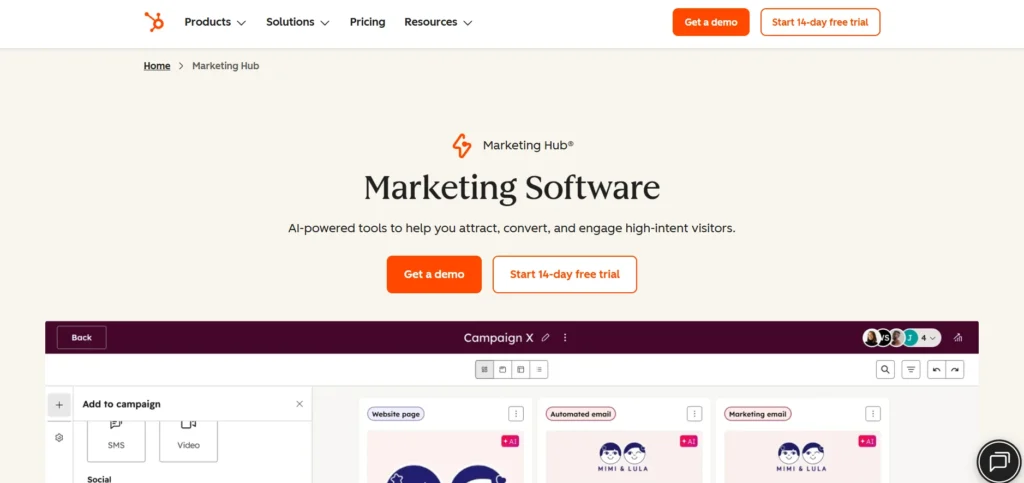
HubSpot Marketing Hub is a B2B automation platform that businesses must have to find an all-in-one solution to inbound marketing, CRM integration, email workflows, and campaign management. It allows teams to follow leads, first visit to closed deal, automate nurturing chains and personalize at scale.
HubSpot makes marketing simpler and more efficient and conversion-driven, with forms, landing pages, search engine optimization, reporting dashboards and automation based on behavior. Its close connection with HubSpot CRM and third-party applications makes it the best choice to optimize sales and marketing alignment.
HubSpot is also one of the top options when it comes to growing companies that require a powerful automation without having to struggle with technical issues.
Website: https://www.hubspot.com/
Key Features:
- Unified CRM with deeply integrated marketing automation suite.
- Drag-and-build workflows for personalized multi-stage email nurturing.
- Smart segmentation using behavior tracking and lead activity insights.
- Landing pages, forms, and SEO tools in one place.
- Real-time analytics dashboards for campaign performance decisions.
Pricing:
- Starter– ₹752/mo/seat
- Professional– ₹66,697/mo
- Enterprise– ₹300,000/mo
2. Marketo Engage
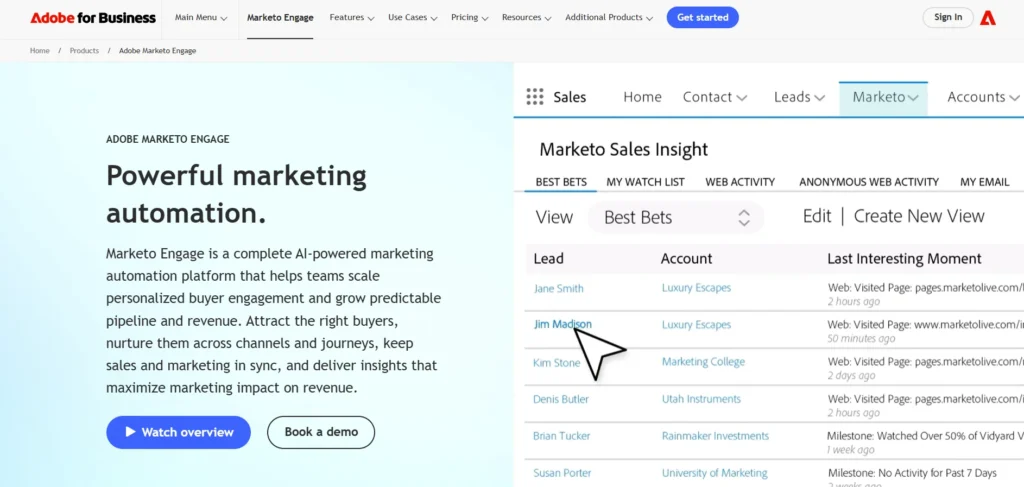
Marketo Engage by Adobe is enterprise-grade B2B marketing automation with advanced lead management and predictive scoring, segmentation, and multi-stage orchestration of campaigns.
It is brilliant at multifaceted buyer experiences and account-based marketing (ABM), enabling marketing organizations to develop more individually customized, cross-channel engagement paths. Marketo is deeply connected with CRMs such as Salesforce and allows sales visibility and pipeline predictions.
Its analytics based on AI allows it to streamline the nurturing flows and find high-intent accounts quicker. Major B2B companies select Marketo because of its scalability, level of automation, and capacity to manage thousands of dynamically changing workflows. Marketo is a necessity to businesses of long sales cycles and multi-touch campaigns.
Website: https://business.adobe.com/products/marketo.html
Key Features:
- Enterprise automation with advanced cross-channel journey orchestration.
- Deep segmentation capabilities for personalized ABM experiences.
- Predictive lead scoring powered by AI-based behavior trends.
- Integrations with Salesforce and enterprise Martech ecosystems.
- Multi-touch attribution to measure entire funnel impact.
Pricing:
- Contact sales
3. Pardot
Pardot (Salesforce Account Engagement) is one of the best B2B marketing automation platforms specially designed for Salesforce-centric businesses. It enables marketing teams to automate email sequences, track lead behavior, score prospects, execute ABM campaigns, and pass the most sales-ready leads directly to CRM pipelines.
With ROI reporting, lifecycle dashboards, and lead qualification automation, Pardot provides clarity across marketing-to-sales handoff. Its strength lies in unified data, making it easier to measure which campaigns drive revenue.
For companies already using Salesforce, Pardot is a must-have tool for building scalable nurture programs, increasing sales efficiency, and delivering personalized engagement throughout the buyer journey.
Website: https://pi.pardot.com/
Key Features:
- Salesforce-native automation for complete CRM-linked buyer lifecycle.
- Lead scoring, grading, and lifecycle qualification rules.
- Sales alignment through real-time prospect engagement notifications.
- ROI dashboards to measure revenue contribution by campaigns.
- Smooth ABM workflows with account-level engagement visibility.
Pricing:
- Contact sales
4. Salesforce Marketing Cloud
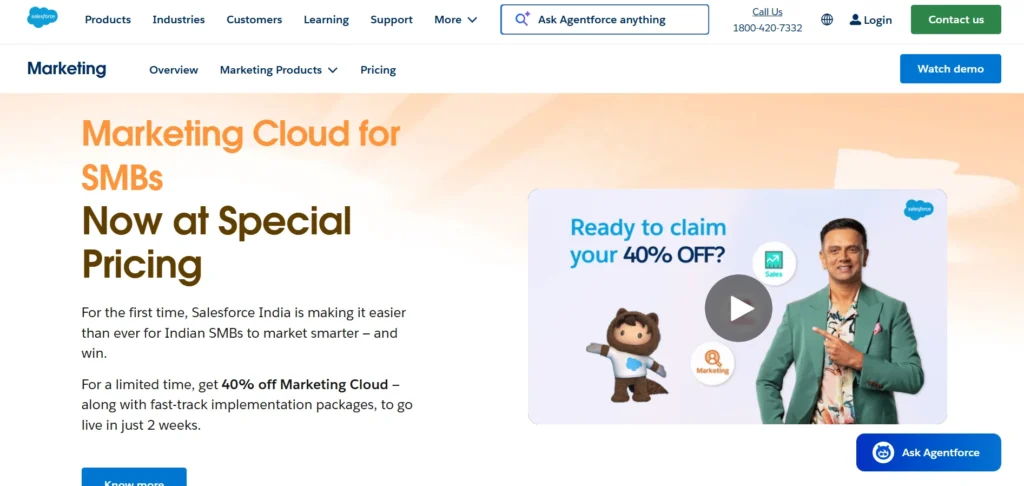
Salesforce Marketing Cloud is an enterprise-friendly B2B marketing tool designed with capabilities across email, social, SMS, advertising, and web journeys and the multi-channel automation that the enterprises need. It assists marketers to provide personalized content in each touchpoint, and forecast the engagement performance with AI intelligence generated by Einstein.
The large-scale customer visibility in its CRM allows it to segment better, nurture leads and collaborate with sales. Marketing Cloud enables use of the dynamic content, audience targeting, and the massive workflows based on the automatizing, which is vital to the revenue-based teams.
Companies that have complex or global sales networks use it to consolidate data, speed up conversion, and operate exceptionally scalable customer experiences.
Website: https://www.salesforce.com/marketing/
Key Features:
- Omnichannel automation across email, SMS, ads, and web.
- Einstein AI for predictive personalization and content targeting.
- Journey Builder creates dynamic multi-step marketing flows.
- Large-scale automation suitable for global enterprise operations.
- Audience segmentation using unified customer experience data.
Pricing:
- Salesforce Starter– $25 USD/User/Month
- Marketing Cloud Growth Edition– $1,500 USD/Org/Month
- Marketing Cloud Advanced Edition– $3,250 USD/Org/Month
5. Oracle Eloqua
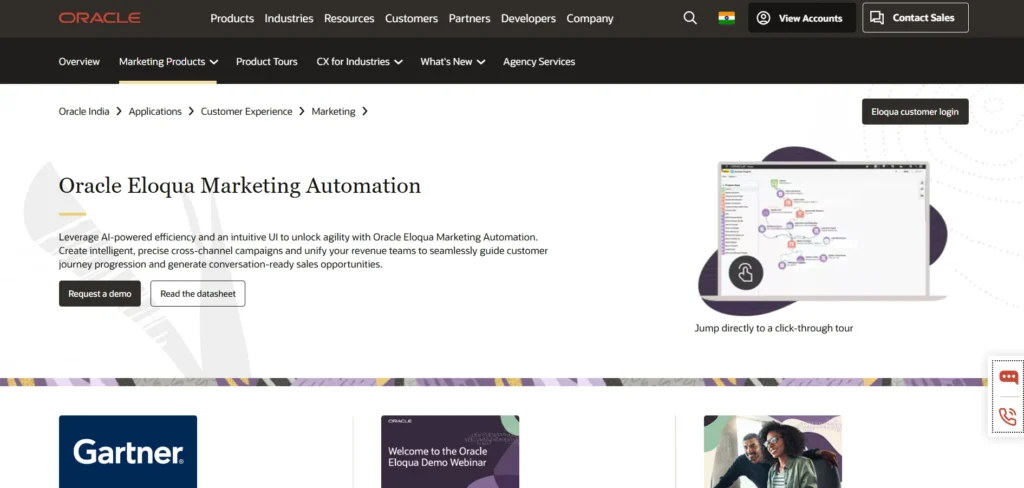
Oracle Eloqua is a leading solution among B2B marketing automation platforms, designed for businesses that require complex campaign management, advanced segmentation, and large-scale lead nurturing. It excels in multi-step workflows, responsive rules, and highly personalized engagement journeys, making it ideal for long and complex B2B sales cycles.
Eloqua offers finer lead scores, account intelligence, and real-time tracking to advance qualified prospects to sales quicker. It has a rich integration ecosystem that stretches into CRM, ERP and ABM systems, which is why it is highly versatile in large organizations with heavy technology stacks.
Eloqua continues to be the best solution to global B2B firms in need of depth in automation, operational control, and revenue impact, with powerful analytics and enterprise scalability.
Website: https://www.oracle.com/in/cx/marketing/automation/
Key Features:
- Sophisticated multi-step campaign builder for complex nurturing workflows.
- Advanced segmentation engine using behavioral and firmographic data.
- Lead scoring models configurable for multi-persona B2B funnels.
- Deep CRM integrations including Salesforce, Oracle, Microsoft.
- High-scale automation for global enterprise marketing operations.
Pricing:
- Request Pricing
6. Act-On
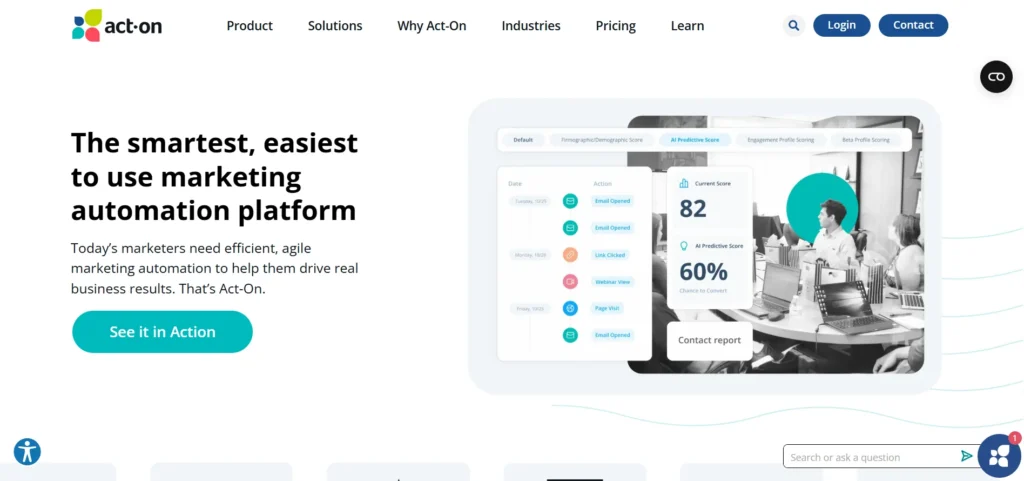
Act-On is a versatile B2B marketing automation solution designed to provide enterprise-grade functionality at enterprise-level pricing. It provides email automation, lead scoring, landing pages, and webinars, analytics, and CRM integrations but is less difficult to onboard and operate.
Act-On assists B2B marketers in cultivating prospects over the channels, automation of repetitive processes, and monitoring engagement along the pipeline. Simple, scalable, and real-time analytics make it an effective option when small-to-mid-market teams are to be considered.
Act-On is a tool that any organization that is expanding its automation maturity and has more potential than simple email programs will need, with less complexity than bigger suites but more capability than smaller ones.
Website: https://act-on.com/
Key Features:
- Automation with strong focus on mid-market B2B usability.
- Lead scoring and progressive profiling for targeted nurturing.
- Automated webinars, landing pages, and event-based triggers.
- Real-time analytics for funnel visualization and optimization.
- Integrates well with CRM tools and sales systems.
Pricing:
- Professional– $900 per month
7. SharpSpring
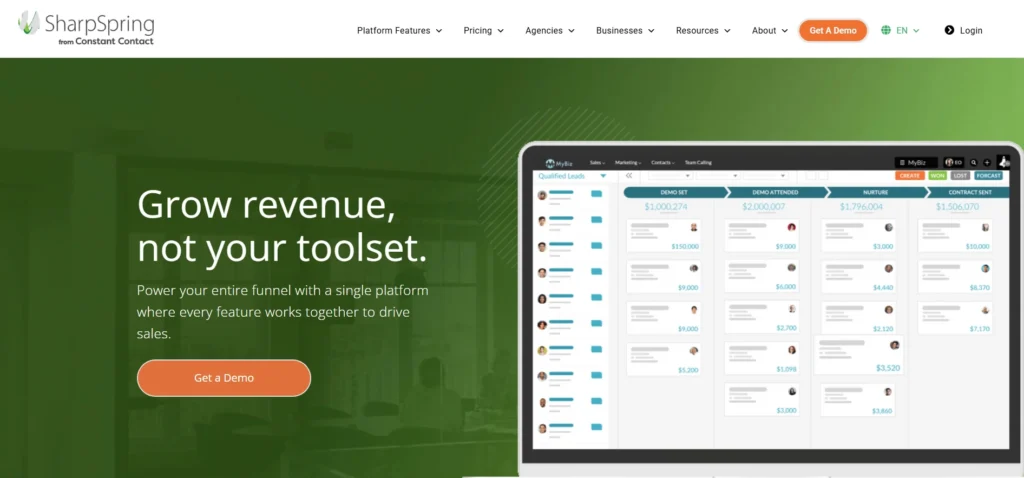
SharpSpring is a must-have B2B automation platform for agencies, SMBs, and fast-scaling businesses seeking strong automation at an affordable price. It includes email workflows, CRM, lead scoring, landing pages, dynamic content, and analytics—all bundled into one unified solution.
SharpSpring’s standout value lies in its agency-friendly pricing and white-label capabilities, making it ideal for businesses managing multiple client accounts. Marketing teams can automate nurturing journeys, personalize messages based on behavior, and track ROI from first click to close.
SharpSpring delivers enterprise-style capability without steep licensing cost, making it perfect for companies wanting power, flexibility, and scalability without overspending.
Website: https://sharpspring.com/
Key Features:
- Affordable automation with CRM and email built-in.
- Visual campaign builder for multi-trigger nurturing workflows.
- White-label rebranding ideal for marketing agencies.
- Lead tracking from first touch to revenue closure.
- Dynamic content personalization based on behavior and attributes.
Pricing:
- $11,988/annually
- $850/monthly
8. ActiveCampaign
ActiveCampaign is an essential tool among B2B marketing automation platforms for companies that value ease of use, strong email personalization, and integrated CRM workflows. It supports automated sequences, behavioral targeting, pipeline automation, site tracking, and predictive sending—allowing teams to deliver relevant messages at the right moment.
Its visual automation builder simplifies campaign setup, making it ideal for marketers without deep technical experience. ActiveCampaign shines in mid-market environments where relationship building matters, offering segmentation, lead scoring, and deal management.
For businesses wanting advanced automation power with minimal complexity and cost overhead, ActiveCampaign remains one of the most effective must-have solutions.
Website: https://www.activecampaign.com/
Key Features:
- Powerful email automation with customizable drip sequences.
- Sales pipeline CRM with task automation and follow-ups.
- Site and event tracking for behavior-based engagement triggering.
- Predictive sending optimizes email delivery per user behavior.
- Strong segmentation and personalization for higher engagement rates.
Pricing:
- Enterprise– $145/mo Billed annually
- Pro– $79/mo Billed annually
- Plus– $49/mo Billed annually
- Starter– $15/mo Billed annually
9. Zoho Marketing Plus
Zoho Marketing Automation is a must-have for small-to-mid-sized B2B firms looking for affordability, CRM integration, and multi-channel automation in one ecosystem. It automates email campaigns, segmentation, lead scoring, and omnichannel engagement with social, SMS, and analytics tools built in.
When paired with Zoho CRM, it enables unified data flows for better lead management and pipeline visibility. Zoho’s intuitive UI, low learning curve, and flexible pricing make it ideal for teams transitioning from manual execution to automated marketing.
For businesses wanting complete marketing functionality without heavy cost or infrastructure, Zoho is a value-driven automation platform worth adopting.
Website: https://www.zoho.com/marketingplus/
Key Features:
- Omnichannel automation across email, social, SMS, and campaigns.
- Unified platform when combined with Zoho CRM ecosystem.
- Lead scoring rules based on profile and engagement history.
- Real-time analytics and attribution for campaign ROI measurement.
- Budget-friendly automation built for SME marketing teams.
Pricing:
- ₹1,500/month billed annually
- ₹1,800/month
10. GetResponse
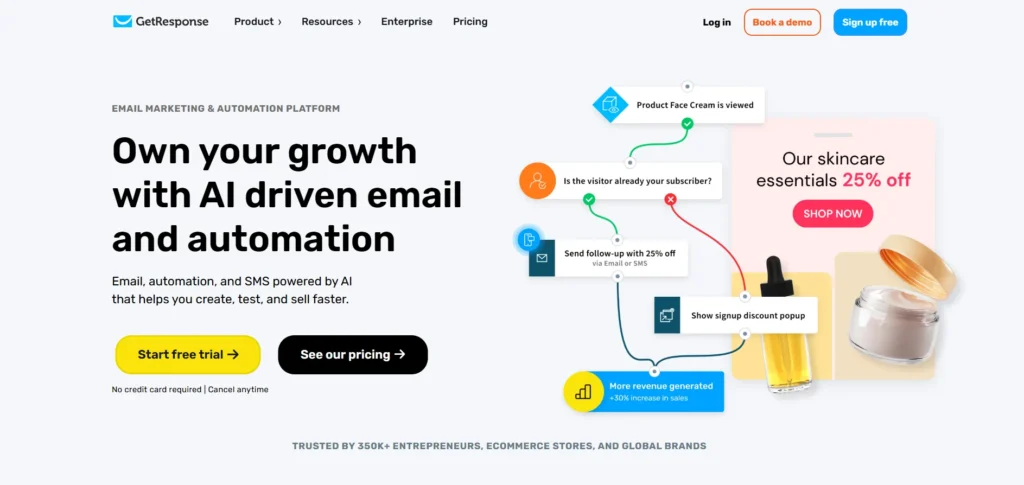
GetResponse is a must-have automation system for B2B teams needing email marketing, webinars, landing pages, funnels, and automation sequences under one low-cost platform. It offers drag-and-drop automation workflows, conversion funnels, lead scoring, and retargeting—all without technical barriers.
Its built-in webinar hosting makes it unusually powerful for companies generating leads through live events and demos. GetResponse suits startups and SMBs wanting foundational automation without enterprise contracts or onboarding difficulty.
From lead capture to nurture to conversion, it streamlines end-to-end digital campaigns. Its balance of pricing, accessibility, and scalability makes it an excellent must-have for early-stage B2B automation adoption.
Website: https://www.getresponse.com/
Key Features:
- Email automation with funnels and conversion-focused templates.
- Built-in webinar hosting for interactive lead generation.
- Autoresponders and journey mapping for continuous nurturing.
- Landing pages and signup forms without coding skill.
- Automated retargeting with audience segmentation and list tracking.
Pricing:
- Starter– ₹1708.58/mo
- Marketer– ₹5305.58/mo
- Creator– ₹6204.83/mo
11. Mailchimp
Mailchimp is a must-have entry-level solution among B2B marketing automation platforms for organizations looking to streamline email marketing, segmentation, and basic campaign automation. While widely used by e-commerce companies, its capabilities extend to B2B lead nurturing, newsletters, forms, A/B tests, and behavior-triggered workflows.
Mailchimp excels in usability—allowing even non-technical teams to launch automated journeys quickly. It includes templates, analytics, and customer audience insights, making it a reliable starting point for businesses new to automation.
Though not as advanced as enterprise tools, Mailchimp is perfect for startups and SMBs aiming to grow messaging automation without operational complexity.
Website: https://mailchimp.com/
Key Features:
- Easy automation flows ideal for beginner B2B teams.
- Email campaigns with drag-and-drop creative builder.
- Segmentation based on audience behavior and demographics.
- A/B testing and optimization tools for campaign refinement.
- Templates, content studio, analytics in one interface.
Pricing:
- Essentials– ₹385/mo
- Standard– ₹575/mo
- Premium– ₹11,500/mo
12. EngageBay
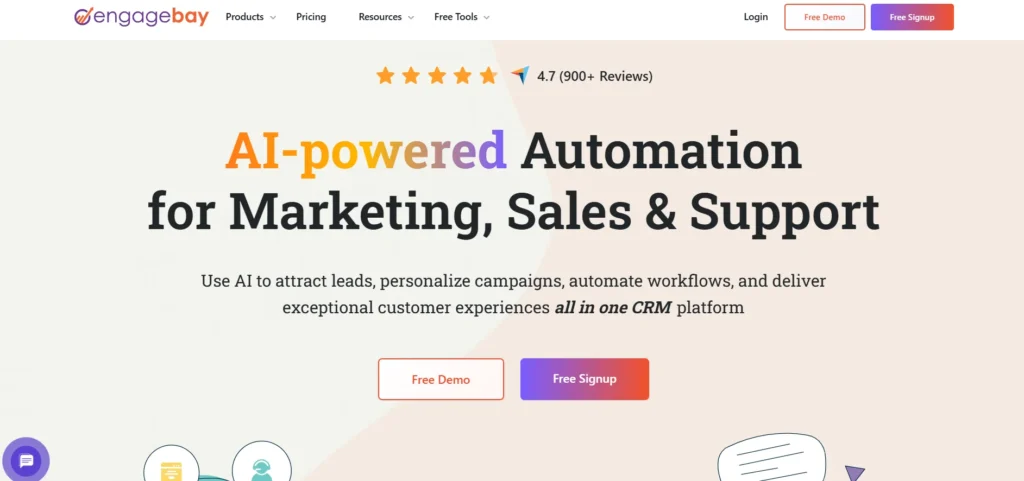
EngageBay is a must-have platform for B2B startups and cost-conscious organizations requiring an all-in-one suite for marketing, sales, automation, and CRM. It offers email sequences, lead scoring, landing pages, appointment scheduling, and omnichannel workflows—without steep subscription fees.
Its unified system removes silos between marketing and sales, ensuring leads are tracked, nurtured, and converted smoothly. EngageBay’s automation builder allows businesses to run drip campaigns, segment audiences, and measure performance easily.
Designed for growing companies with limited resources, EngageBay offers tremendous value and capability, making it a highly practical, scalable, and budget-friendly automation choice.
Website: https://www.engagebay.com/
Key Features:
- All-in-one CRM, email, automation and support suite.
- Visual workflow builder with drip campaign personalization.
- Lead scoring and full journey tracking for sales readiness.
- Live chat, forms, landing pages included natively.
- Budget-friendly for startups scaling B2B automation fast.
Pricing:
- Basic– $11.04 per user/month
- Growth– $42.49 per user/month
- Pro– $67.99 per user/month
13. Demandbase
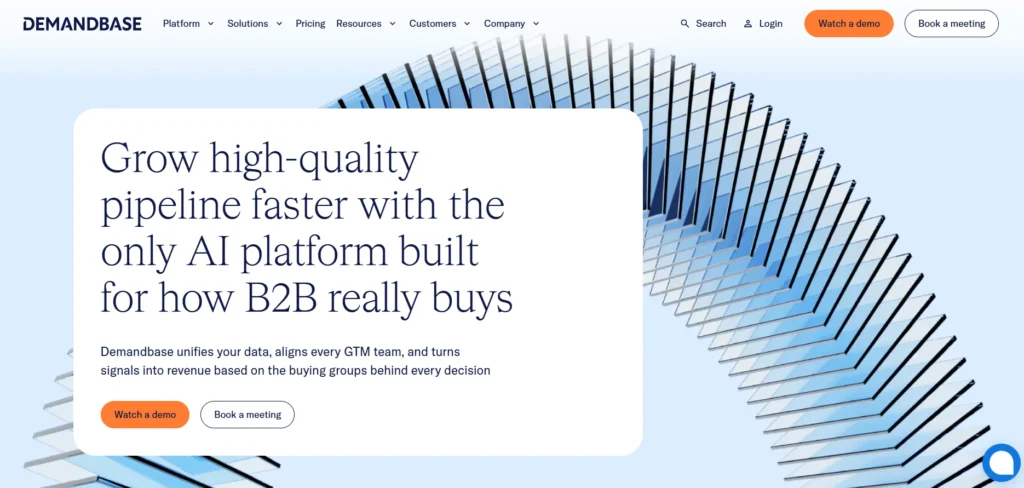
Demandbase is a must-have B2B automation and ABM platform used by enterprises focused on targeting high-value accounts rather than mass leads. Its AI-powered insights enable marketers to identify buying intent, personalize outreach, and trigger campaigns based on account behavior.
Demandbase unifies intent signals, advertising, segmentation, lead qualification, and analytics for account-centric programs.
It is built for companies selling to large clients with complex decision-making units and long buying cycles. With deep B2B data enrichment and predictive engagement capabilities, Demandbase improves win-rates, accelerates pipeline velocity, and supports revenue-driven ABM at scale.
Website: https://www.demandbase.com/
Key Features:
- ABM-first automation platform built for target account engagement.
- Intent data identifies prospects showing buying interest.
- AI-based audience targeting improves outreach precision.
- Multi-channel campaign automation for B2B enterprise scaling.
- Deep analytics for measuring pipeline impact of accounts.
Pricing:
- Custom Pricing
14. Bloomreach
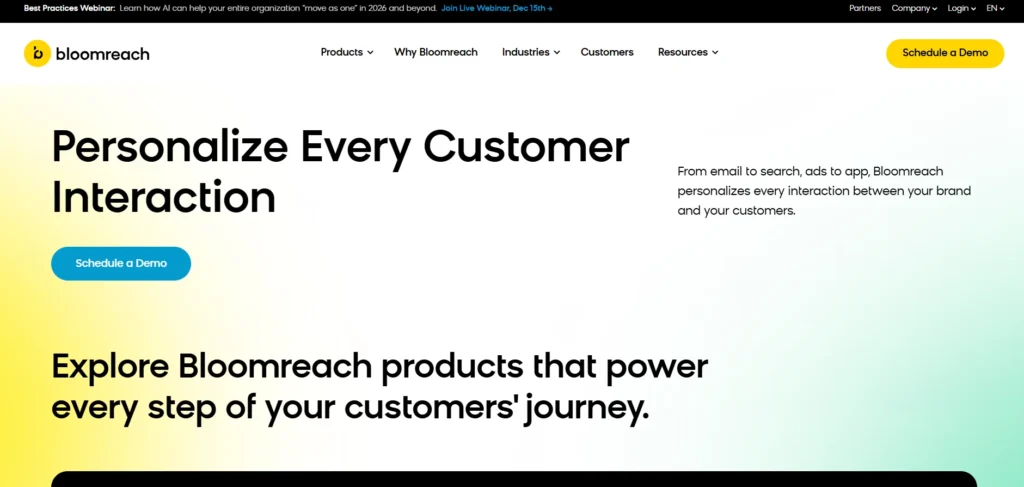
Bloomreach is a must-have solution among B2B marketing automation platforms for companies that rely heavily on digital content, personalization, and experience-driven conversion. It offers automation for email, AI recommendations, content optimization, behavioral segmentation, and omnichannel engagement.
Bloomreach’s strength lies in combining automation with content intelligence, allowing marketers to dynamically tailor website and campaign messaging based on buyer intent. It is especially valuable for B2B organizations with large product or content catalogs.
With its personalization engine and scalable campaign workflows, Bloomreach helps increase engagement, shorten buying cycles, and create relevant experiences across customer touchpoints.
Website: https://www.bloomreach.com/en
Key Features:
- AI-driven personalization for content and user experience.
- Marketing automation paired with strong content intelligence.
- Customer segmentation using real-time behavioral indicators.
- Omnichannel delivery for email, web, and commerce journeys.
- Great for content-heavy B2B digital experience optimization.
Pricing:
- Request Pricing
15. LeadSquared
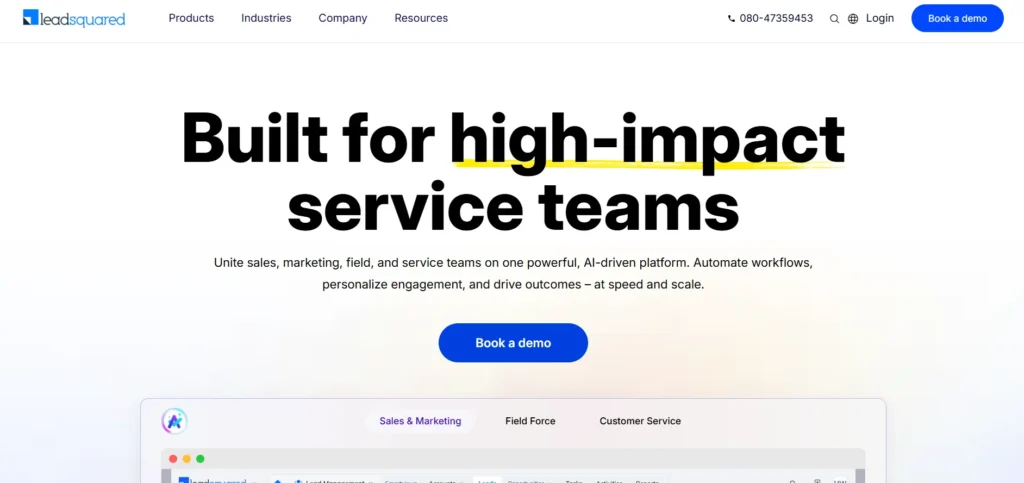
LeadSquared is a must-have B2B automation platform for fast-moving sales organizations needing robust lead capture, workflow automation, and CRM-linked nurturing. It automates drip campaigns, lead scoring, sales routing, pipeline tracking, and multi-channel communication—including email, WhatsApp, and calls.
LeadSquared is widely used in SaaS, education, healthcare, BFSI, and manufacturing sectors due to its simplicity and speed of deployment. Its real-time lead engagement visibility helps sales teams respond faster and close deals more efficiently.
For businesses focused on conversion acceleration and sales-marketing alignment, LeadSquared is a powerful, scalable automation system.
Website: https://www.leadsquared.com/
Key Features:
- Automation centered on fast lead capture and routing.
- CRM-linked workflows for sales-marketing alignment at scale.
- Multi-channel communication: email, SMS, WhatsApp, telephony.
- Lead scoring and qualification for pipeline efficiency.
- Highly adoptable for education, SaaS, BFSI and healthcare.
Pricing:
- Marketing Pro– ₹90,000 per account
- Marketing Super– ₹149,000 per account
Ending Thoughts
In conclusion, B2B marketing plays a crucial role in helping businesses connect with the right partners, clients, and decision-makers who drive organizational growth. As buyer expectations rise and digital transformation accelerates, B2B marketing automation platforms enable companies to adopt smarter strategies, leverage data-driven insights, and deliver personalized communication to stay competitive.
Modern B2B marketing goes beyond simple promotion—it builds credibility, nurtures long-term relationships, and aligns marketing with sales to create a unified customer experience. With tools like marketing automation, ABM, analytics, and CRM integrations, businesses can streamline their efforts and improve conversion efficiency. Ultimately, successful B2B marketing focuses on delivering real value, solving complex business challenges, and supporting sustainable, revenue-driven growth.
FAQs
What is B2B Marketing?
B2B marketing refers to strategies and techniques used by businesses to promote products or services to other businesses rather than individual consumers. It focuses on value, efficiency, and long-term relationships.
How is B2B Marketing Different from B2C Marketing?
B2B marketing targets professional buyers and organizations, involves longer sales cycles, requires more detailed information, and emphasizes ROI, whereas B2C focuses on emotional triggers and faster buying decisions.
What Channels are Most Effective in B2B Marketing?
Effective channels include email marketing, content marketing, LinkedIn, webinars, SEO, account-based marketing (ABM), and marketing automation platforms.
Why is Marketing Automation Important in B2B?
Automation helps nurture leads, personalize communication, streamline workflows, and align marketing with sales, improving conversion rates and efficiency.
What is ABM (Account-Based Marketing)?
ABM is a targeted B2B strategy that focuses on engaging high-value accounts with personalized campaigns designed specifically for their needs and buying behavior.