
The experience of starting a business in India is adventurous. You possess the idea, the money, and the success objective. However, you must first choose the appropriate type of company. The option is called Company Registration.
One of the most important and initial decisions made is the selection of the business structure. The following types of Company Registration in India are not mere legal formality; they ensure the value of the tax you pay, your personal property would still be secured in the event that the business goes under, and that it is easier to access funds through investors.
Being confused with such names as LLP, Pvt Ltd, or Sole Proprietorship, you may breathe a relief. You are in the right place. At the conclusion of this guide, you will be well aware of the type of structure to use in your dream.
Introduction
India is a country where the business environment is expanding at a high rate. It is no longer only big companies but college graduates with ideas on technology, people who do home baking and then make it their business, and freelance consultants who expand their operations.
To give you an idea of its size, see the following numbers:
- 112,718 is the number of startups that are identified by DPIIT in 2023, and thus India has become the third-largest startup ecosystem worldwide.
- 1.5 lakh and above- new businesses of one fiscal year, indicating a massive growth in formal businesses.
- 63 million, the real figure of the MSMEs (Micro, Small, and Medium Enterprises), which are the workhorses of our economy.
- 40 percent- the lightening of compliance weight on the shoulders of business, courtesy of new governmental measures on the Ease of Doing Business.
These figures indicate that India is business-friendly. To be a part of that, however, you must have a legal identity.
In today’s blog, we will explore seven different Types of Company Registration in India in depth.
Why Understanding Company Registration is Crucial for Indian Business
Suppose you are a builder of a house you do not own. That’s risky, right? Operating a business without registration or failing to select a proper registration is close.
The registration of the company is the birth certificate of your business. In the absence of it, your business is not recognized in the law as an entity. Unless your business is registered, you can not open a bank account, apply for a loan, or even sue your customer who failed to pay.
Investors, be it friends, family, or even venture capitalists, will not invest in a business that is not established properly. They should be aware of the shareholders and who bears the losses. Knowing the structures will prevent you from surrendering rights or putting your family assets at risk.
What Is Company Registration in India?
Definition and Scope
Registration of the company refers to the registration of your business with the Ministry of Corporate Affairs (MCA) or other local registration bodies. It transforms your idea into a business or hobby into a legal business. Your company is registered and has its identity. It may own property, assume debt, be sued, as well as sue, and be sued, independent of you, the owner.
Business Registration vs Tax Registration.
This is a widespread source of misunderstanding.
- Business Registration informs the government of the structure of your business (e.g., Private Limited, LLP).
- Tax Registration (similar to GST or PAN) informs the government about the amount that you owe.
Overview of Business Structures in India

There are numerous types of business structures available in India depending on the needs. Independent entrepreneurs, a family business, friends partners, or a startup intending to operate globally, all have a suitable structure. The Companies Act, 2013, governs these structures, and the limited liability partnership Act, 2008, as their principal laws.
The Reasons Why Company Registration is important.
What is the point in making all the paperwork? Why not simply sell and hold on to the cash? Here are the reasons:
- Limited Liability Protection- In Pvt Ltd or LLP, in case the business collapses, the bank has no ability to sell your personal home or vehicle. It is just the amount of money you put in that you risk.
- Brand Value and Trust- Customers will have a stronger trust on a Pvt Ltd company than a vendor that has no name. It demonstrates that you are professional and serious.
- Finance -You cannot issue shares to investors when you have a Sole Proprietorship. You must have a formal company such as a Private Limited Company to raise equity.
- Perpetual Succession – A registered company such as the Pvt Ltd survives even in the event of the death or departure of the founder. The business has its own life.
Comparison Table: Types of Company Registration in India
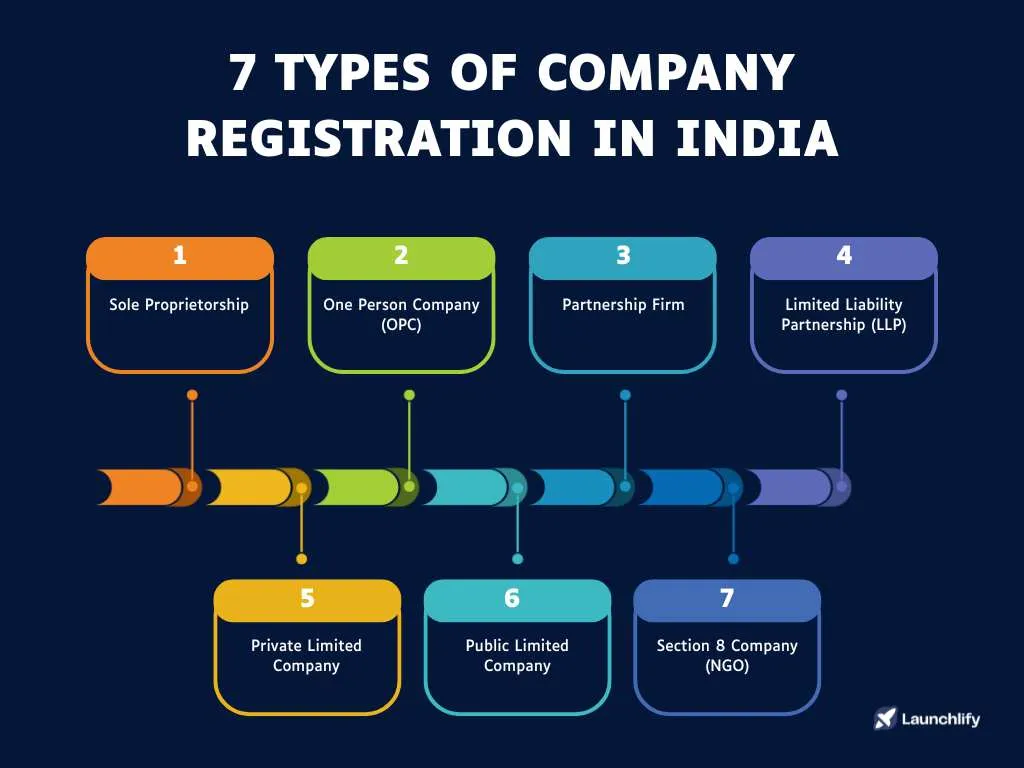
To make you scan the differences fast, the most popular structures are compared.
| Type of Registration | Owners Required | Liability | Ideal For | Compliance Level | Fundraising Ability |
| Sole Proprietorship | 1 | Unlimited | Freelancers, small shops | Very Low | ❌ No |
| One Person Company (OPC) | 1 | Limited | Solo founders wanting safety | Medium | ❌ Limited |
| Partnership Firm | 2–50 | Unlimited | Family & trusted partners | Low | ❌ No |
| Limited Liability Partnership (LLP) | 2+ | Limited | Professionals & agencies | Low–Medium | ⚠️ Difficult |
| Private Limited Company | 2–200 | Limited | Startups & growth businesses | High | ✅ Yes |
| Public Limited Company | 7+ | Limited | Large enterprises & IPOs | Very High | ✅✅ Yes |
| Section 8 Company (NGO) | 1+ | Limited | Social & charitable work | Medium | Grants / CSR |
What Is the Best Company Registration in India?
There is no single “best” type. Making the right decision is absolutely about what you are aiming at.
Sole Proprietorship is recommended when you are a freelancer, small shop owner and trying a business with very low risk and low budget.
- Select Private Limited when you have a startup idea, intend to have employees, wish to seek the financing of investors or wish to offer employees stock options (ESOPs).
- Select LLP when you are starting to establish a consulting firm, marketing agency, or legal practice together with a partner and you would like to avoid paying a lot of compliance costs but preserve your personal assets.
- Select OPC when you are an individual founder desiring the professional image and liability protection of an enterprise but is not yet able to find a co-founder.
7 Company Registrations in India
There are 7 Company Registrations in India.
Now we can take a closer look at the seven major types of registrations. We are going to examine their meanings, targeted audience, and advantages and disadvantages.
1. One Person Company (OPC)
Prior to 2013, to start a company, you had to have at least two people in case you wanted to form one with Limited Liability. The reform of the Companies Act, 2013 was the One Person Company (OPC). An OPC is a hybrid structure. It enables one individual entrepreneur to be in charge of a corporate entity in limited liability. It is considered as a distinct legal person, other than its owner, but you should nominate a so-called Nominee, who will assume control of the company in the event of your death or incapacitation.
Key Benefits:
- Limited Liability –Your own savings are at no risk.
- Professional Image– It is more convincing to your clients to use your name with OPC Pvt Ltd after it than it is with a proprietorship.
- Sole Ownership: You are the 100% shareholder and controller.
Eligibility:
- Only a natural person, which is an Indian citizen and a resident in India, may incorporate an OPC.
- You must appoint a nominee.
Advantages & Disadvantages:
- Pro: The marriage of the benefits of a proprietorship and the security of a company.
- Con: Tax rate is high (typically a flat 30) in comparison to slab rates on proprietorship.
Ideal Candidates:
Individuals who are solo entrepreneurs, consultants, or artisans but do not need a co-founder and want to keep their business and personal life separate to reduce their business risks.
2. Sole Proprietorship
The easiest, oldest and most prevalent type of business in India is Sole Proprietorship. It is a “one‑man show.” The owner and the business are not legally different in this form of structure. You are the business. Provided the business makes a profit, then it is yours. If it makes a loss, it’s yours. Registration is not even compulsory; it is normally your GST registration or Shop and Establishment Act license which is a demonstration of proprietorship. It is the least difficult method of simply beginning.
Key Benefits:
- Zero Complexity -No complex registration with the Ministry of Corporate Affairs (MCA).
- Complete Domination– You are the boss. Everything is decided by you at a moment.
- Tax Benefits: You are treated as an individual; therefore, you have the ability to use individual slab rates.
- Privacy- You do not need to put your accounts in front of the people.
Eligibility:
- You must be an Indian citizen.
- You required a PAN card and a bank account.
Advantage & Disadvantage:
- Advantage: Least difficult and least expensive to establish and shut.
- Disadvantage: Unlimited Liability.
Ideal Candidates:
The owners of local grocery stores, freelance writers, graphic designers, small tutors, and home-based bakers who have no intentions of attracting external capital.
3. Public Limited Company
The elder brother of the Pvt Ltd is A Public Limited Company. Where a Pvt Ltd would not be able to sell the shares to the general populace, a Public Limited Company can. This is the form needed in case you wish to take your company to the stock market (IPO). It is built to handle large scale operations hence requiring huge capital on the part of the population. The government laws regarding this structure are the most stringent because of the involvement of the public money.
Key Benefits:
- Massive Capital: You are able to raise money amongst the masses.
- Prestige: It is a Public Limited Company, which means that you are a big player.
- Easily Procured Shares: of a stock may be bought and sold easily in the stock market (when listed).
Eligibility:
- 7 Shareholders and 3 Directors minimum.
- No restriction on the number of shareholders per maximum number.
Advantage & Disadvantage:
Advantage:
- No limit in terms of capital raising.
Disadvantage:
- It has a very high compliance burden.
- All regulators such as SEBI are ever on your neck.
- A lot of privacy is lost because all information should be public.
Ideal Candidates:
Big amalgamates, well-established firms that intend to issue an IPO, and utility firms that are in need of huge amounts of capital.
4. Pvt Ltd Company
This is the gold standard of the start-ups and developing businesses in India. A small number of people (shareholders) own a Private Limited Company. It is not a personal entity as it is independent and can own property and have debts on its own name. The shares are the shares that determine the ownership. When you have 50 percent on the shares, you own 50 percent of the company. It makes the difference between the Owners (Shareholders) and the Managers (Directors), whereas in startups, initially, it is likely to be the same group of people.
Key Benefits:
- Funding Ready: This is the structure that is only preferred by VCs and Angel Investors.
- Limited Liability- The shareholders are solely liable to the amount of their unpaid share capital.
- Employee Incentives- You may offer ESOPs (Employee Stock Ownership Plans) to lure in the best employees.
- International goodwill- internationally reputed.
Eligibility:
- 2 Directors and 2 Shareholders (may be the same).
- Maximum 200 Shareholders.
- One of the Directors should be an Indian resident.
Advantage & Disadvantage:
Advantage
- Bigger scale, ownership is easily transferred, and a high legal status.
Disadvantage:
- You have to conduct board meetings, submit annual returns to MCA, have audits and have statutory registers. It is also costlier to keep as compared to an LLP.
Ideal Candidates:
Technology startups, e-commerce, high growth organizations, and anybody with the intention to raise external capital.
5. Limited Liability Partnership (LLP).
The LLP is a good compromise between a traditional Partnership and a Private Limited Company which was introduced in 2008. Under normal partnership, liability of a mistake committed by another partner is possible on one of the partners. In an LLP, that doesn’t happen. It has the advantage of providing Limited Liability as a company with the operating flexibility of a partnership. It is controlled by a mere “LLP Agreement” rather than the complicated Companies Act.
Key Benefits:
- No Audit Requirement: You do not have to have a compulsory audit unless your turnover is more than 40 Lakhs or capital contribution is more than 25 Lakhs.
- Tax Efficiency: No Dividend Distribution Tax (however, it varies with the fiscal policies, however, profit withdrawal is usually less difficult).
- Partners are not responsible for each other for the misconduct of one another.
Eligibility:
- Minimum 2 Partners.
- No maximum limit on partners.
Advantages & Disadvantages:
Advantage:
- It is cheaper to establish and maintain than a Pvt Ltd.
- There is less paperwork.
Disadvantage:
- Investors (VCs) are not willing to invest in LLPs since the process of valuation and sharing of shares is cumbersome as opposed to Pvt Ltd company.
Ideal Candidates:
Professional service providers (Law firms, Architectural firms, Design agencies), Small family businesses and partners who do not require venture capital.
6. Section 8 Company (NGO)
This is not for those who aim to stuff their pockets but to stuff hearts or heal the world. Section 8 Company is a Non-Profit Organization (NPO). It is incorporated to advertise arts, science, business, charity, faith, or environment conservation. The main principle in this case is: Not to take home profits. Any profit which the company will achieve should be reinvested into the cause.
Key Benefits:
- Credibility: It makes the Section 8 company rather than Trust or Society more credible to the donors as it is controlled by the Central Government.
- Tax Exemptions: 80G and 12A eligible, that is, the donors receive tax breaks.
- Limited Liability: The members are not at risk of personal liability.
Eligibility:
- Can be either an individual or an association.
- Objects must be charitable.
Advantage & Disadvantage:
- Advantage: Government grants and CSR (Corporate Social Responsibility) funds.
- Disadvantage: There exist very strict regulations about the usage of money. You are not at liberty to declare dividends.
Ideal Candidates:
Social entrepreneurs, charities, research institute and foundations.
7. Partnership Firm
It is the conventional model of a business in which two or more individuals get together and operate a business. It is under the Indian Partnership Act, 1932. You may get it registered with the Registrar of Firms, or even unregistered (but it is strongly advisable to register it in order to have legal rights). It is dependent largely on the belief amongst the partners.
Key Benefits:
- Simple to form: Simple drafting on stamp paper of Partnership Deed and you are all ready.
- Sharing information via Decision Making: “Two heads are better than one.”
- Low Compliance: Certainly few yearly filings.
Eligibility:
- Minimum 2 partners.
- Maximum 50 partners (usually).
Advantage & Disadvantage:
Advantage:
- Extremely inexpensive to launch.
Disadvantage:
- Unlimited Joint and several liability.
Ideal Candidates:
Local traders who have known each other for years, small, low-risk family businesses. (Note: NB: The majority of experts suggest that it should be LLP rather than Partnership Firm currently).
Conclusion
The selection of the appropriate company registration is akin to constructing a house. The house falls down on a poor foundation. Expenditure on a heavy foundation to a small hut is a waste of money.
- When all you are doing is testing the waters: Sole Proprietorship.
- When you are creating the next unicorn business: Go with Private Limited.
- When you are co-founding a professional agency with a friend: Choose LLP.
Don’t fear paperwork. It has become easy to register online in a short period. Act, institutionalize your dream, and contribute to the development of the economy of India.
Also Read: Flipkart-owned companies
FAQs
1. Would I be able to transform a Sole Proprietorship into a Private Limited Company in future?
Yes, most of them begin as sole proprietorship as a way of saving money before they upgrade to a private limited company when they make more or require money.
2. What is the least expensive company registration in India?
The cheapest form is the sole proprietorship since there are very minimal registration costs. The LLP is less costly to establish and operate as compared to the private limited company in formal companies.
3. Do I require a real office to get a company registered?
No. You can use your home address. All you need to do is show a utility bill and no-objection letter of the owner even in the case of your parents.
4. The duration of registration of a Private Limited Company?
In the new SPICe+ forms, a private limited company can be established in between 5 to 10 working days provided that all your papers are ready.