

The SWOT analysis of Amul Company reveals the success tale of the most reliable dairy brand in India. This win-win giant has changed the lives of millions of farmers as well as established a business worth 72000 crore. Knowing the strategic position of Amul enables us to view the way in which a farmer-owned organisation can compete with multinational corporations, as well as market leadership in the Indian dairy industry.
This is a thorough analysis of the strengths, weaknesses, opportunities, and threats of Amul in the modern competitive market. Amul is an iconic business model with its famous Amul Girl mascot, and is able to process 41 million litres of milk a day. Nevertheless, the company is being affected by the shifting consumer preferences and the increase in competition. We shall discuss how Amul has become a market leader and what challenges might affect its further development in the changing dairy environment.
What Is a SWOT Analysis?
SWOT Analysis is a strategic planning model that assesses the Strengths, Weaknesses, Opportunities, and Threats of an organisation. It is an analytical tool that assists businesses in determining internal abilities and constraints, as well as making judgments on the external market environment. In the case of dairy cooperatives such as Amul, the swot analysis of the Amul company gives an insight into the positioning of the competitor, their resource positioning, and their future growth policies. The framework helps the stakeholders to make wise decisions as the factors affecting the performance of organisations and market sustainability are analysed in a systematic manner.
Overview of the Dairy Industry in India
India’s dairy industry isn’t just big — it’s massive and growing fast. In 2025, the industry was valued at about ₹21,318.5 billion, and it’s projected to nearly triple to around ₹57,859.1 billion by 2034 at a compound annual growth rate (CAGR) of 11.73 % — showing strong demand for milk and dairy products across the country. The northern state of Uttar Pradesh alone accounted for around 18.7 % of the dairy market in 2025, thanks to its large livestock base and high consumption. India also remains the largest milk-producing nation globally, with milk output steadily increasing — recent government data estimates production near 248 million tonnes in 2024-25. Together, these factors position India’s dairy industry as a cornerstone of rural livelihoods and a significant growth engine for the broader food-and-beverage sector.
You Might Like: How To Start A Dairy Farm At Home With Low Investment
Brief Overview of Amul
History
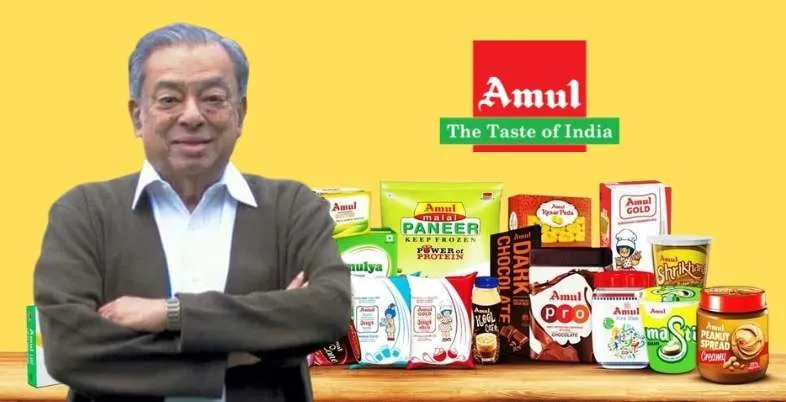
The history of Amul stops in the year 1946, when Tribhuvandas Kishibhai Patel founded the cooperative in Anand, Gujarat, in reaction to the exploitative methods of POLSON Dairy. The organisation launched the White Revolution, also referred to as Operation Flood, which turned India from a milk-deficient country to a global dairy powerhouse. This historical background of farmer empowerment is also dominant in the swot analysis of Amul Company. The cooperative model during the last seventy years helped millions of rural producers to find just markets and create a sustainable livelihood in collective action.
About Brand
Amul is a singular business model, run by the Gujarat Cooperative Milk Marketing Federation Limited (GCMMF), through which the owner is a farmer who owns production and distribution. The name Anand Milk Union Limited signifies the economic development of the grassroots, the acronym. Under the management of Tarun Bhatia as the CEO, the organisation has a high daily production of 41 million litres of milk, which is processed via its extensive network. The Food and Drink Report 2023, which is included in the Brand Finance report, recognised Amul as the strongest dairy brand in the world, which confirms its market position. This collaborative arrangement has a significant impact on the swot analysis of Amul Company as it generates both strengths and business complications.
USP
The unique selling proposition of Amul is a combination of cooperative ownership and uniform quality provision at reasonable rates. The single-brand approach in a wide range of products provides good recall value and minimal marketing investments. Its iconic Amul Girl mascot, with its polka dots and commentary about the happenings of the day, has developed unmatched brand affinity, cutting across generations. In stark contrast to competitors in the corporate sector, Amul avoids putting profits in the pockets of its shareholders and rather repatriates the same to farmer-members, generating accurate stakeholder alignment. It is a unique positioning that makes a vital part of any swot analysis of the Amul company compared to multinationals that deal with dairy companies in India.
Explore Amul Franchise Cost in India
Key Products
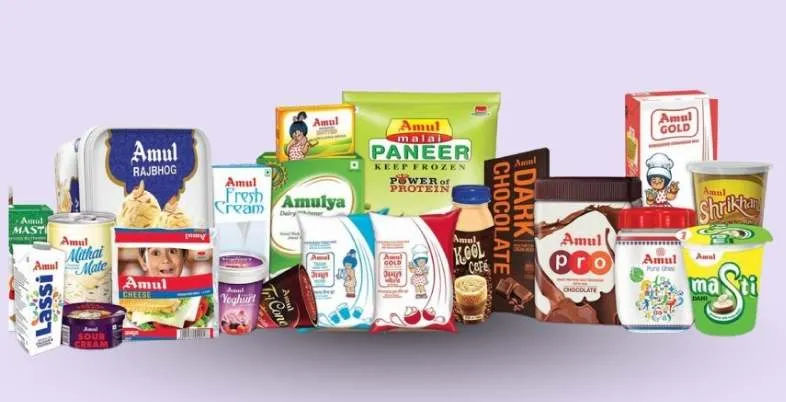
- Milk Products: Fresh pasteurised milk, in different amounts of fat, is to be consumed daily.
- Butter and Ghee: Dairy fats with premium quality that can be used in cooking and preparation of traditional food.
- Ice Cream: Great variety of flavours, which occupy large segments of the frozen dessert market.
- Cheese Varieties: Cheese in various types, such as pizza cheese, which has multiple uses in cooking.
- Drinks: Youth markets Flavoured milk drinks and traditional Indian drinks.
Networth & Growth
- GCMMF revenue (turnover): ₹65,911 crore (~$7.75 billion) in 2024-25, marking an 11 % increase over the previous year’s ₹59,259 crore.
- Total Amul brand revenue: Around ₹90,000 crore (~$10.6 billion) in FY25, up from about ₹80,000 crore in FY24, reflecting double-digit growth across product categories.
- FY 2025-26 projection: Amul is targeting a ₹1 lakh crore revenue milestone (~$12.5 billion).
- Growth Rate: Strong 18% year-over-year business growth, with strength in the market.
- International Ranking: Eighth most prominent dairy firm on the globe with international exportation.
- Production Capacity: around 300 lakh litres of milk per day, with a capacity of 135 metric tons to dry.
- Market Reach: A Distribution channel that will reach one million retailers via 10,000 dealers.
SWOT Analysis of Amul Company (2026)
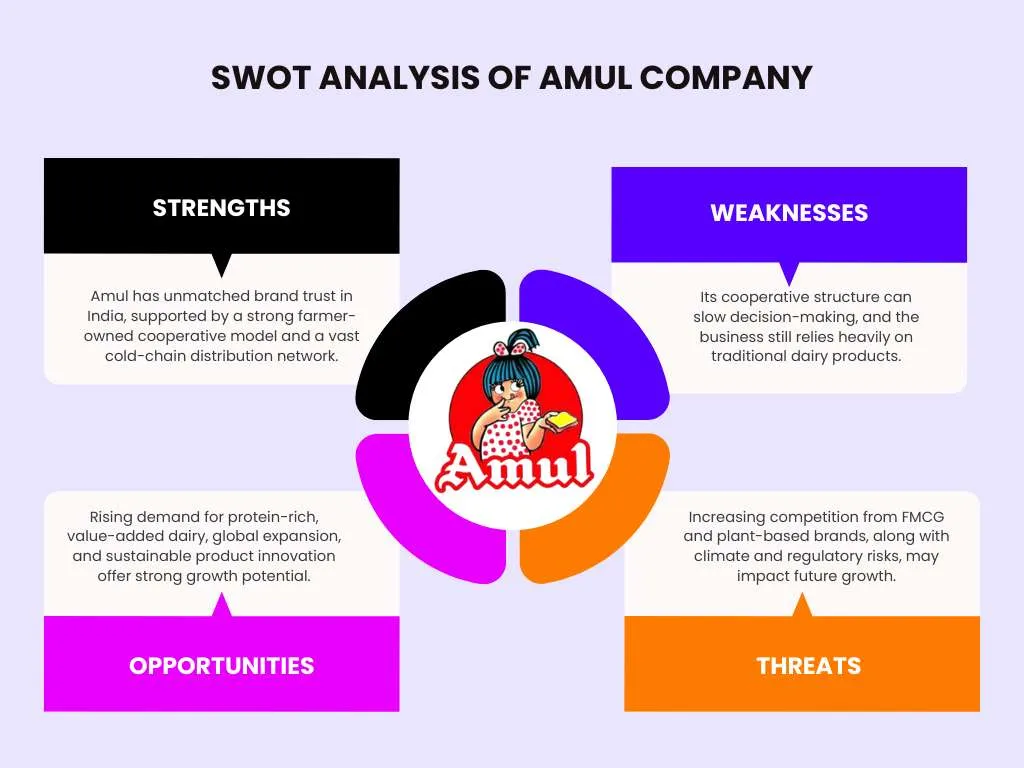
- Cooperative Advantage: This is due to the Farmer-owned structure, stability of the supply chain, and authentic positioning of brand names.
- Brand Recognition: Years of reliability in quality delivery were creating unprecedented consumer confidence in the country.
- Scale of production: Large-scale processing facilities facilitate cost-efficiencies and responsiveness to the market.
- Innovation Investment: Rs 415 crore investment in robotic automation enhances competitive advantage.
- Market Leadership: The leader in the ice cream industry has one-third of the market share.
1. Strengths of Amul Company
Best Quality and Brand Loyalty
The best intangible asset of Amul is consumer trust that has been established over the decades due to the constant quality of the product. Amul means purity and reliability to millions of households in urban and rural India. The swot analysis of Amul Company indicates the way this loyalty can be converted to repeated purchases and reluctance to the competitor’s offer.
Customers have confidence in quality certifications and favourable reviews given by food safety agencies. Their efforts in upholding standards even when prices are under pressure show the long-term strategic thinking ability that the company cannot be easily duplicated by its competitors.
Large Production Capacity
Amul has a scale that provides insurmountable competition to small players since it has processing capacities of 300 lakh litres of milk per day. This is an infrastructure investment that has been built over decades and is capable of helping the organisation to manage seasonal changes in production.
Amul’s large-scale milk processing and distribution capabilities represent a significant strength in its SWOT analysis. The cooperative handles hundreds of millions of litres of milk daily during peak procurement seasons, supported by extensive processing infrastructure, including multiple milk powder drying facilities across India. Managing such massive volumes requires a highly advanced cold-chain and logistics network, a capability that very few organizations in the dairy sector can match. This unmatched production and distribution scale provides Amul with a sustainable competitive advantage, enabling it to serve domestic markets while supporting export operations efficiently.
Market Leader
The ability to control about one-third of the market share of the ice creams in India makes Amul the category leader, which has a considerable price elasticity. The projected growth rate of 4.53 per cent per annum in the frozen dessert segment in the next five years provides a high growth potential.
Even better growth trends of over 20% are observed in the category of flavoured milk and cheese. This market dominance enables Amul to control the channels of distribution and bargain for good retail placements. The Amul Company’s swot analysis reveals the strength of its leadership position, which allows it to be flexible with strategies that are unavailable to smaller rivals.
Unified Brand Name

The single brand approach in various product lines generates marketing economies of scale that save a lot of money on promoting the products. Amul is known to consumers in milk, butter, cheese, ice cream, chocolate, and beverage product categories instantly. This form of consolidation focuses on the advertising strength as well as developing an overall brand equity.
The Amul Girl mascot is a well-known brand that increases brand recall by topical commentary on existing events. The marketing cost is a negligible percentage of the revenues, which illustrates the efficiency of unified branding in this swot analysis of Amul Company.
Invest in Robotics
Investment in automation amounting to 415 crore in four new plants is a sign that it is giving in to technology. The robotic warehouse plant keeps the 50 lakh liters of long-life milk in dense arrangements. All these technological abilities reduce the labour expense and enhance the quality consistency as well as business efficiency.
High automation will allow production to scale quickly without the proportionate rise in the number of people needed to work. Swot analysis of the Amul company reveals that technology adoption is a very essential differentiator in an industry that has been very difficult to modernise.
2. Weaknesses of Amul Company
Cooperative Structure
Farmer ownership has supply benefits, whereas the consensus-based decision-making process generates organisational inertia. Competitors with centralised companies are able to react faster to the change in the market than cooperative ones. The strategic projects that involve excessive capital input have a lengthy approval process encompassing the various stakeholder groups.
To some extent, this type of governance does postpone product releases and market reaction. The swot analysis of Amul Company recognises the manner in which cooperative democracy, despite its philosophical worth, leads to operational constraints within the fast-moving consumer goods market.
Operational Cost
High reliance on dairy unions and agricultural communities exposes them to the risk of fluctuating the price of raw materials. The higher the expectation of the farmers, the higher the procurement cost, which narrows the profit margin on the price-sensitive products. The huge management system behind cooperative activities puts administrative burdens that are not present in corporate rivals.
Various price changes as the supply cost varies confuse the consumers and could lead to the loss of their loyalty. This is one of the cost structure challenges that is found to be recurrent in all swot analyses of Amul Company, as it is a challenge management has always faced.
Portfolio Expansion
Amul, in spite of the diversification attempts, is finding it difficult to compete on an even playing field with its non-dairy products, in comparison to the traditional dairy products. The chocolate products are highly competitive with the established brands such as Cadbury and Nestle, with better category associations.
Extension of the brand to new categories would mean immense marketing investments without necessarily having to be accepted by the consumers. The dairy specialist’s perception places a constraint on credibility on those categories that are far away from core competencies. The issue of expansion is a significant limitation found in the swot analysis of Amul Company.
Brand Perception
Extreme affinity to dairy products builds psychological impediments among consumers when they think of Amul in non-traditional sections. Consumers of chocolate automatically pick the brands of established confectionery instead of alternatives that are dairy-related. It takes marketing investments that might not give corresponding returns to break these perception barriers.
The specialisation in the dairy industry turns out to be a demerit in diversification. This perception issue is identified in the swot analysis of Amul Company as the restriction of growth potential on core categories.
Use of Plastic
The issues of environmental sustainability bring about reputational risks since Amul still packs and uses plastic and straws. The company’s request to delay the ban on plastic straws caused negative publicity from environmental advocacy groups. Plastic materials that are minimally recyclable are used in wrapping milk packets, juice packets and cheese.
The younger generation is increasingly taking into consideration the environmental impact when making their purchase decisions, which may influence brand perception. The weakness is a sustainability aspect, which is evident in the current swot analysis of Amul Company evaluations.
3. Opportunities for Amul
Growth in Milk Consumption
India’s milk production has continued its upward trajectory, increasing from approximately 221 million metric tonnes in 2021–22 to around 230 million metric tonnes in 2022–23, reinforcing the country’s position as the world’s largest milk producer. This growth is driven by a rising population and increasing awareness of protein-rich diets across income groups. At the same time, rapid urbanization is reshaping consumption patterns, creating strong demand for value-added dairy products such as flavored milk, yogurt, cheese, and fortified dairy beverages.
This consumption growth is one of the major growth drivers identified by the swot analysis of Amul Company. Medical practitioners are advising more on the use of dairy protein in nutrition, which favours category development. Demand is also boosted in rural markets through government nutrition programs, which involve milk products.
International Markets
The world market of dairy milk is expanding at a compound annual growth rate of 5.1 per cent, which is expected to reach 1.5 trillion dollars in 2032. The collaboration of Amul with Michigan Milk Producers Association facilitates the distribution of fresh milk in the US in the East Coast andthe Midwest. It can be seen that Indian dairy brands are internationally viable, as evidenced by export to more than 50 countries.
The markets of Asia have some of the best opportunities in view of cultural similarities and the increasing population of the middle classes. The swot analysis of Amul Company focuses on internationalisation as the key to growth to overcome the growth limits domestically.
Chocolate Product Line Expansion
The chocolate market in India, with a valuation of 3.8 billion in 2023, is estimated to grow to 9.2 billion with an estimated CAGR of 6.1% in 2032. Amul has the money to invest heavily in research, development, and marketing of the chocolate categories.
Market share can be achieved faster with strategic takeovers of smaller chocolate companies. The premium chocolate segments have better margins than the traditional dairy products. This type of opportunity has been predominant in future swot analysis of Amul Company suggestions regarding portfolio diversification.
E-commerce Opportunities
The Indian e-commerce is expanding at an annual rate of 18.29% and is projected to reach 136.47 billion by 2026. Through online retail stores, Amul is able to access consumers without having to go through intermediaries, which would result in the intermediary margins and distribution expenses. Urban millennials who are pursuing convenient home delivery can be accurately targeted with digital means.
E-commerce enables the launch of high-quality products that do not need much space in physical shelves. The Amul company’s swot analysis reveals the need to embrace digital transformation as a way of competing with technologically enabled startup food companies.
4. Threats to Amul
Increasing Competition
The high level of competition is posed by multinational companies such as Hindustan Unilever (Kwality Walls) and foreign franchises such as Baskin-Robbins. These brands are Mother Dairy, London Dairy, Havmor, and regional brands, which compete fiercely for market share in terms of the category.
The Indian dairy industry encourages foreign direct investment due to the presence of the best marketing budgets and innovativeness. Retail chain brands provide competition in terms of prices on their own labels in the commodities. This level of rivalry is a continuous issue in the Amul Company’s swot analysis.
Lawsuits
Competitors pose reputational risks and financial liabilities in terms of lawsuits related to comparative advertising. The Bombay High Court decision to indict Amul in 2017 on disparagement of competitor products created precedents. Litigations on intellectual property regarding packaging designs and product formulations create constant costs of litigation.
There are regulatory compliance issues in different states that expose the company to litigation. Legal risks in the highly litigious business environment of Amul Company should be included in the swot analysis of the company.
Negative Media Coverage
Harsh coverage of the media on the use of plastics, payment issues with farmers, or concerns about the quality of products quickly go viral on social media. The 24-hour news cycle exaggerates the adverse incidents, which may not have a real effect on the business.
This is because competitor-sponsored journalism, under the guise of journalism, is a negative aspect of brand reputation. Media stories surrounding the dairy subsidy debate by the government policy are controversial. Contemporary swot analysis of the Amul company reveals the media management issues that are present across the board.
Negative Online Reviews
Online platforms also magnify personal customer dissatisfaction into viral scandals that impact the brand image. The quality of products, even a single case, creates thousands of negative reviews that would be clear to potential buyers.
False negative narratives through competitor manipulation of review platforms generate the need for constant monitoring. The management of consumer expectations is now essential as social media gives more power to the vocal minorities. Online reputation management has been identified as a priority in the activities of the swot analysis of Amul Company.
Growth in Preference for Plant-Based Substitutes
According to the Rakuten Insight surveys, more than 44 per cent of the Indian people who use plant-based products do so because they are healthier or more ethical. The adoption of a vegan lifestyle, especially by the urban youth, poses a threat to the traditional dairy consumption patterns. Oat milk, almond, and soy substitutes secure shelf space that was previously occupied by dairy products.
Some consumers are being influenced to eat plant-based diets because of environmental issues surrounding livestock farming. This change in diet indicates an existential threat, which was pointed out in all prospective swot analyses of the Amul company.
SWOT Analysis of Amul Ice Cream
- Brand Extension Brand equity that Amul had developed successfully translates into the frozen dessert categories.
- Distribution Network: A wide network of retail outlets that ensures that the products are available in a wide range of geographic markets across the country.
- Flavor Innovation: extensive selection of flavours that serve the local taste and seasonal needs.
- Price Competition: Premium positioning constrains the volume expansion in the price-sensitive rural and semi-urban markets.
- Demand by the season: The production planning and inventory management are issues due to variations in the consumption of ice cream.
Conclusion
This is a detailed swot analysis of Amul Company, which indicates that the organisation possesses strong forces in the form of cooperative structure, brand equity and production scale. The swot analysis of Amul Company has shown that to be successful, there must be a balance between the interests of the farmer and the competitiveness in the market as it adopts technological innovation and sustainability practices. With India’s dairy giant traversing the international markets, a strategic focus based on the organised SWOT analysis would be the key to remaining at the top of the industry pack that is becoming more and more complex.
You Might Like: Chhaswala Franchise Cost
FAQs
What is the largest strength of Amul?
Sustainable competitive advantages in the nation are developed due to brand loyalty and large production capacity.
What is the problem with a cooperative structure?
Decisions made by consensus retard responses by the markets as opposed to centralized corporate market competitors.
What market has growth potential to Amul?
The international markets hold the potential of expansion as international dairy consumption is growing steadily.
What are the risks to the market position of Amul?
The traditional dairy is challenged by plant-based alternatives and the strong competition of multinationals.