


The advent of generative AI engines, such as ChatGPT, Claude, Gemini, and Perplexity, has changed the digital marketing world in a seismic way. These platforms are also radically transforming the way users find information, and traditional approaches to search engine optimisation are only a component of the equation.
With the fight to stay visible in this new paradigm, specialised GEO Tools for AI Search & SEO Optimisation have become an essential part of keeping track of brand mentions, keeping track of citations, and learning how AI systems interpret and present your content.
It is a comprehensive guide to fifteen innovative platforms that can assist businesses, content creators, and marketers to survive in the complicated world of AI-enhanced search. Be it a small startup that is exploring the waters or a large enterprise that wants to use advanced competitive intelligence, knowing what GEO Tools can offer regarding the AI Search and SEO Optimisation, and their usage with your particular needs, is the key to remaining unnoticed in the digital arena or becoming a well-known brand.
What is GEO?
Generative Engine Optimisation (GEO) is the new stage of digital visibility strategies. In contrast to conventional SEO, which aims at ranking in the search engine results page, GEO involves positioning your brand, products, or services in AI-generated responses on platforms such as ChatGPT, Gemini, Perplexity, and Claude.
The engines make use of numerous sources and compose complete answers to the questions that the users pose to these AI systems.
AI search and SEO optimisation, GEO Tools assist you in knowing where your contents are found in these replies, how many times you are referenced, and what your competitors are taking over in your industry.
Essential Features to Look for in GEO Tools for AI Search & SEO Optimisation
When choosing the appropriate platform, it is necessary to know what features can provide you with actual value in your particular use case. The market has available a variety of solutions, starting with a rudimentary monitoring dashboard to an advanced optimisation terminal. Weigh the capabilities and advantages of every tool against the size of your team, its technical knowledge, financial limitations and the strategic goals of the team.
- Multi-Engine: The most powerful AI search and SEO optimisation GEO Tools must follow your brand on numerous generative engines such as ChatGPT, Gemini, Claude, Perplexity, and Google AI Overviews.
- Competitive Benchmarking: contextualization is required to know where you stand.
- Citation and Source Tracking: Moving beyond mere mentions, a more complex platform will show where the AI engines are accessing when talking about your brand on the exact pages, articles, or other resources.
- Quick Level Observations: Various queries made by users provide varying results.
- Actionable Recommendations: Even the best platforms do not only relay data but transform the research into tangible content changes, organisational adaptations, and strategic prescriptions that can be used to improve how AI systems understand and reference your work.
Comparison Table for Top 15 GEO Tools for AI Search & SEO Optimisation
| Tool Name | Rating | Best Feature |
| Writesonic | 4.3/5 | Integrated content creation with GEO insights |
| AthenaHQ | 4.5/5 | Comprehensive multi-engine competitive analysis |
| Otterly AI | 4.0/5 | Affordable entry-level monitoring solution |
| Goodie | 4.6/5 | All-in-one visibility and sentiment tracking |
| Peec AI | 4.2/5 | Clean dashboards with straightforward metrics |
| Scrunch AI | 4.4/5 | AI-ready site creation platform (AXP) |
| Semrush AI Visibility Toolkit | 4.5/5 | Seamless integration with existing SEO workflows |
| Profound | 4.7/5 | Reliable citation tracking with direct answer links |
| AirOps | 4.4/5 | Workflow-integrated publishing guidance |
| Ahrefs Brand Radar | 4.6/5 | Extensive keyword database leveraging |
| xFunnel AI | 4.3/5 | Buyer journey question mapping |
| Geostar | 4.5/5 | AI bot crawl monitoring and source analysis |
| Search Party | 4.4/5 | Real user prompt data collection |
| Rankscale | 4.1/5 | Economy pricing with visibility scoring |
| Frase | 4.5/5 | Content brief generation for AI readiness |
Top 15 GEO Tools for AI Search & SEO Optimisation
1. Writesonic
Rating: 4.3/5
Website: https://writesonic.com/
Best Use Cases: Content creation teams needing integrated GEO analytics capabilities
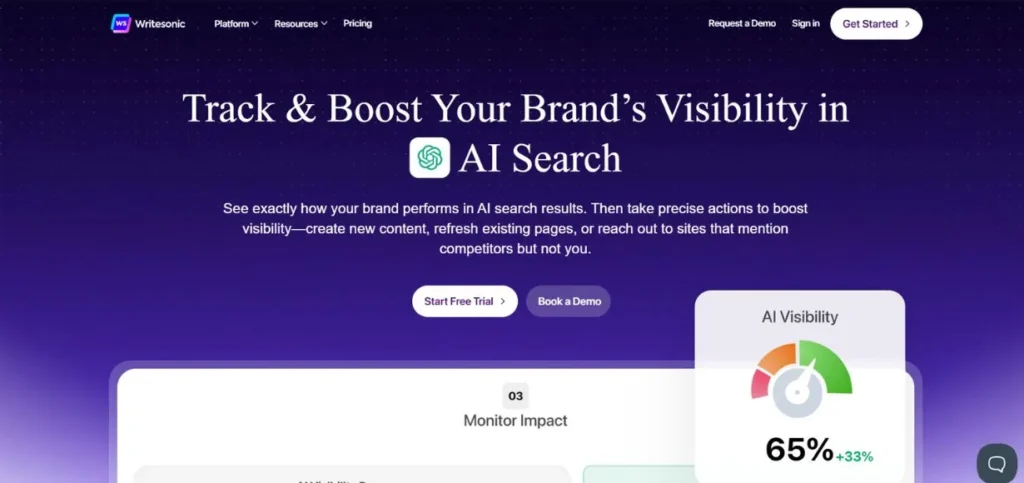
Writesonic fills the gap between monitoring the visibility and the real development of the content. Instead of merely recording the presence of your brand in the AI-generated responses, this platform is actively involved in assisting teams in creating and optimising content that can be easily absorbed, interpreted, and referenced by generative engines.
Although its competitive analysis functions are not as in-depth as dedicated monitoring tools, Writesonic is best at converting GEO intelligence into direct content enhancements, which is why it would best fit the teams in which writers and SEO experts work hand in hand.
Key Features:
- Basic mention tracking
- Citation data analysis
- Content structure recommendations
- Topic coverage gaps
- Clarity improvement suggestions
Pros:
- Affordable entry pricing
- Intuitive writing interface
- Direct optimisation guidance
Cons:
- Limited competitive depth
- Less monitoring focus
- Weaker analytics suite
Pricing: Plans start at $39 per month
Also Read: Best AI Tools for Product Managers
2. AthenaHQ
Rating: 4.5/5
Website: https://writesonic.com/blog/athenahq-review
Best Use Cases: Organisations requiring comprehensive visibility tracking with robust competitive intelligence
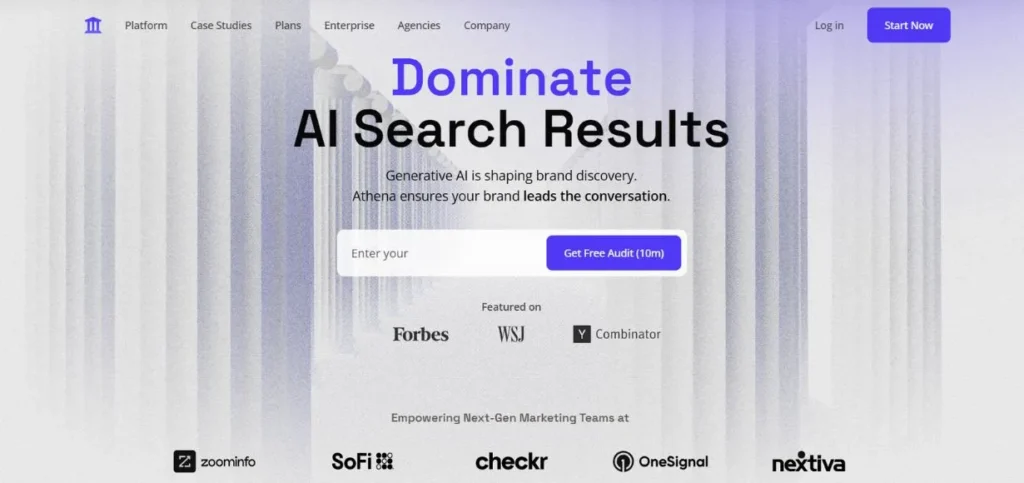
AthenaHQ also markets itself as a data-first solution to teams that do not need its content creation support but require proper monitoring. The platform runs comprehensive prompts on all leading generative AI engines, providing comprehensive reports on the presence of brand, frequency of citation, and performance of competitors.
The platform puts accurate measurement and reporting at the core instead of content editing or optimisation recommendations, and therefore it is the most appropriate in organisations that have independent content units and require reliable intelligence to drive their strategies. The premium initial price will consider its business-level features and extensive engine coverage.
Key Features:
- Multi-engine prompt execution
- Detailed citation verification
- Competitive presence mapping
- Topic-level gap analysis
- Trend tracking dashboards
Pros:
- Accurate monitoring data
- Strong competitive context
- Enterprise-grade reliability
Cons:
- Higher starting price
- No content tools
- Steeper learning curve
Pricing: Basic plans begin at $295 monthly
3. Otterly AI
Rating: 4.0/5
Website: https://otterly.ai/
Best Use Cases: Budget-conscious teams or early GEO adopters testing visibility strategies
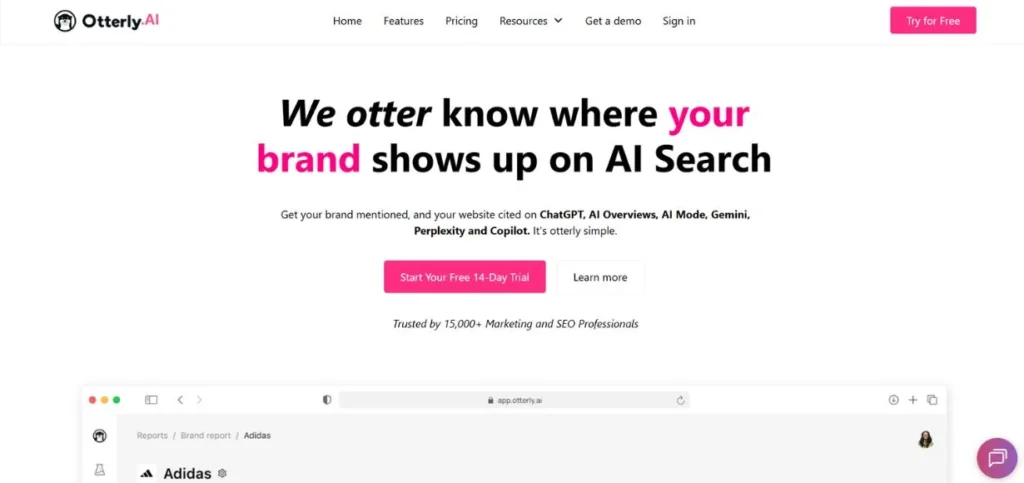
Otterly AI is an easy-to-use point of entry to organisations that have started their course into generative engine optimisation. The platform provides basic brand tracking on leading AI engines at no cost or complexity for the enterprise.
Users also have a clear understanding of the location of their brand in the AI-generated responses, simplified citation tracking and advanced presence metrics. The platform demonstrates that it is not necessarily the case that effective visibility monitoring needs enterprise budgets.
Key Features:
- Basic brand mentions
- Simple citation tracking
- High-level presence metrics
- Multi-engine coverage
- Straightforward dashboard interface
Pros:
- Extremely affordable pricing
- Easy to understand
- Quick setup process
Cons:
- Limited analytical depth
- Minimal competitive features
- Basic reporting options
Pricing: Entry-level access starts at just $29 per month
4. Goodie
Rating: 4.6/5
Website: https://higoodie.com/
Best Use Cases: Brands seeking a comprehensive visibility platform with optimisation recommendations
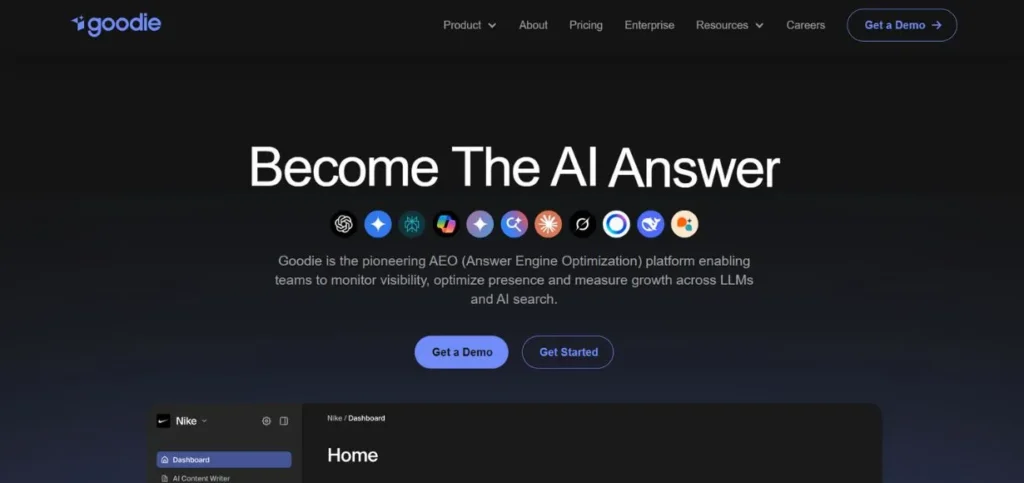
Goodie is offered as a comprehensive solution to those organisations that are serious about getting AI-driven visibility mastered. The platform tracks brand mentions, citations and sentiment in the entire generative engine range that includes ChatGPT, Gemini, Claude, and Perplexity.
Goodie is unique in that it is content in its entirety; it does not merely show where you are but, additionally, guides you toward why a specific content is working and gives you tips on how to improve it to be better understood by the AI. The whole nature of the platform and the individualised onboarding procedure are embodied in custom pricing.
Key Features:
- Sentiment analysis tracking
- Global multi-engine monitoring
- Competitive comparison dashboards
- Narrative optimisation tools
- Actionable improvement recommendations
Pros:
- All-in-one solution approach
- Strong optimisation guidance
- Comprehensive engine coverage
Cons:
- Quote-based pricing only
- Requires demo commitment
- May overwhelm smaller teams
Pricing: Custom pricing
5. Peec AI
Rating: 4.2/5
Website: https://peec.ai/
Best Use Cases: Mid-sized organisations wanting clean tracking without overwhelming complexity
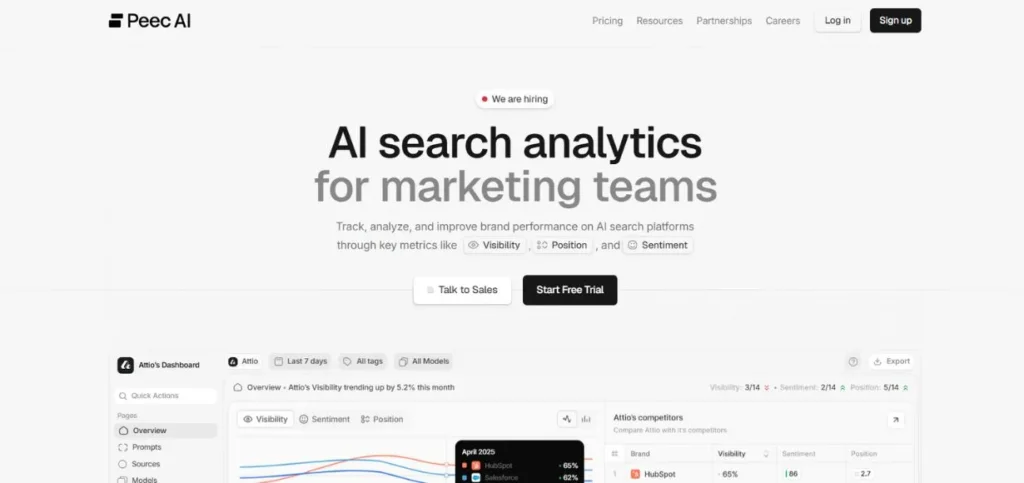
Peec AI offers a strategic balance between features and ease of use, which is especially compelling to mid-sized teams that require a dependable AI Search and SEO Optimisation GEO Tools that do not have the feature bloat of enterprise applications. The tool tracks brand visibility, mentions and citations across AI-answer systems and then displays the information in clean and intuitive dashboards that are more focused on presenting the information rather than being overly detailed.
The platform is incredibly effective with the organisations where several stakeholders will require to survey of GEO performance, yet do not need to access technical details in a more detailed manner. The pricing approach in euros used in Europe shows the market orientation of the company.
Key Features:
- Simple dashboard design
- Competitive comparison views
- Basic trend analysis
- Citation tracking functionality
- Multi-engine monitoring coverage
Pros:
- Clarity-focused interface
- Quick data access
- Reasonable pricing point
Cons:
- Limited recommendation depth
- Basic analytics only
- Less comprehensive features
Pricing: European plans start at $89 monthly
6. Scrunch AI
Rating: 4.4/5
Website: https://scrunch.com/
Best Use Cases: Teams wanting visibility tracking plus AI-ready content preparation
Scrunch AI will differentiate with AXP (AI Experience Platform), which offers AI-optimised versions of websites to assist generative engines to be more effective to interpreting and citing content. On top of typical visibility tracking, which shows the presence of brands in AI-generated responses, Scrunch offers prompt-by-prompt insights, which can tell which individual queries, topics, and user profiles are most likely to mention brands and which are performing poorly.
This is an attractive combination that suits those organisations that require both measurement and optimisation in one platform.
Key Features:
- Prompt-level visibility data
- AXP site optimisation
- Regional performance tracking
- AI traffic views
- Persona-based analysis
Pros:
- Content readiness tools
- Detailed prompt insights
- Regional tracking capabilities
Cons:
- Mid-tier pricing point
- Learning curve for AXP
- Complex feature set
Pricing: Standard plans begin at $250 monthly
7. Semrush AI Visibility Toolkit
Rating: 4.5/5
Website: https://www.semrush.com/kb/1493-ai-visibility-toolkit
Best Use Cases: Existing Semrush users extending SEO capabilities into AI visibility
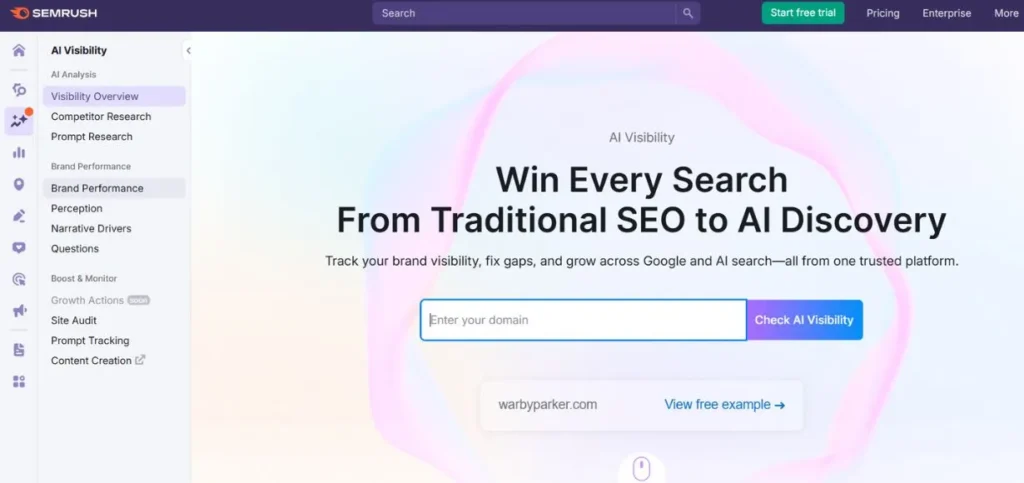
To those organisations that already invest in the Semrush ecosystem, the AI Visibility Toolkit represents an extension of the already existing search engine optimisation processes. This add-on will be able to seamlessly integrate GEO tracking into existing Semrush interfaces instead of forcing teams to learn new platforms.
The fact that it is possible to compare traditional search ranks with AI visibility implies strategic information that could not be found in single GEO tools.
Key Features:
- Integrated Semrush workflow
- Visibility overview dashboards
- Brand performance reporting
- Prompt tracking (US)
- Competitor benchmarking
Pros:
- Familiar interface design
- SEO and GEO integration
- Consolidated reporting platform
Cons:
- Requires a Semrush subscription
- US-only prompt tracking
- Limited standalone functionality
Pricing: Custom pricing
Also Read: Best SEO Tools
8. Profound
Rating: 4.7/5
Website: https://www.tryprofound.com/
Best Use Cases: Teams prioritising accurate citation tracking with consistent monitoring
Exceptional reliability, accuracy in following brand mentions, citation and competitor presence on the leading AI engines biases its high rating. The feature that will distinguish the platform is that it will give direct links to certain AI-generated answers that refer to your content and will not create any confusion as to where and how your brand will be displayed.
Although Profound is a tool that cannot be considered as an optimiser of content, but a tool that optimises the process of content optimization. It is important to note that its accuracy and reliability make it invaluable to organisations that require reliable GEO Tools to develop their strategies based on the intelligence of AI Search and SEO optimisation.
Key Features:
- Direct answer linking
- Precise citation tracking
- Steady trend analysis
- Broad query coverage
- Accurate competitive comparisons
Pros:
- Exceptional reliability metrics
- Clear citation attribution
- Comprehensive monitoring scope
Cons:
- Limited optimization features
- Monitoring-focused only
- No content guidance
Pricing: Plans start at $99 monthly
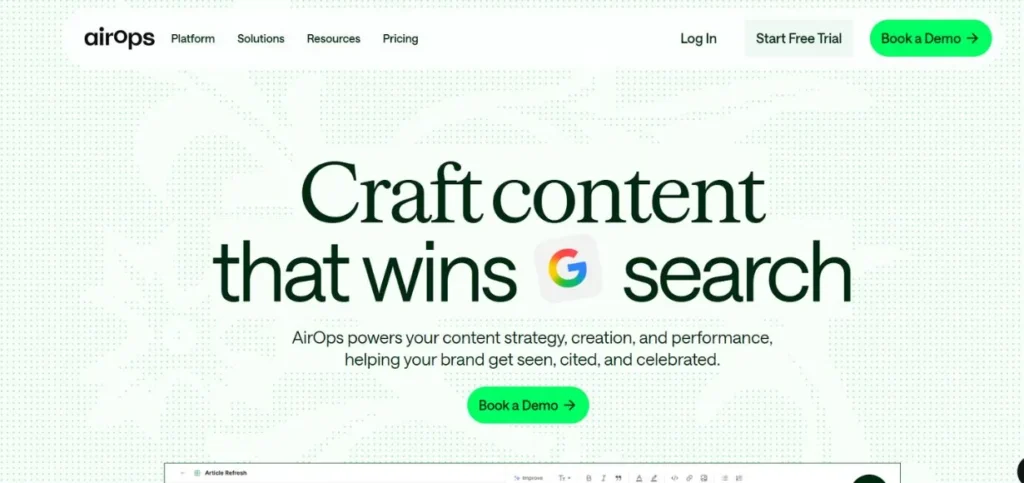
9. AirOps
Rating: 4.4/5
Website: https://www.airops.com/
Best Use Cases: Publishing teams integrating GEO insights into content workflows
AirOps is a workflow-oriented approach to generative engine optimisation featuring a direct connection between the visibility data and the content publishing processes. Instead of considering GEO monitoring a distinct activity, the platform integrates insights into the daily work of content teams, pointing out the areas of weakness in coverage, unresolved questions, structural problems, and ways to improve as the team plans and produces content.
The advantages of the platform are in its ability to make optimisation feasible and accessible to non-technical staff who produce content but might not be well-versed in the technicalities of AI visibility. Custom pricing gives an option to customise to particular workflows and printing volumes in an organisation.
Key Features:
- Workflow integration tools
- Coverage gap identification
- Question research functionality
- Structure improvement guidance
- Publishing process embedding
Pros:
- Practical content guidance
- Workflow-native approach
- Non-technical user friendly
Cons:
- Custom pricing only
- Less competitive analysis
- Requires workflow integration
Pricing: Custom pricing
10. Ahrefs Brand Radar
Rating: 4.6/5
Website: https://ahrefs.com/brand-radar
Best Use Cases: Ahrefs subscribers extending their SEO stack with AI visibility
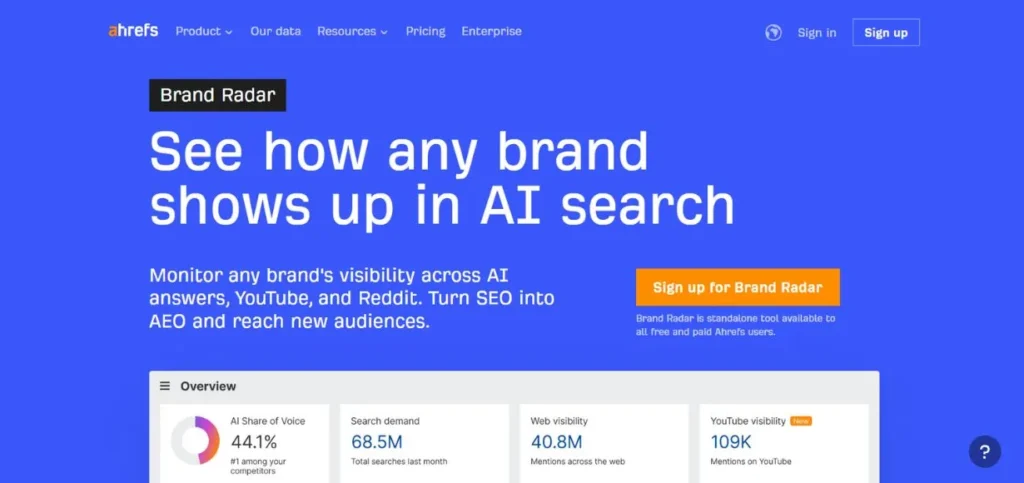
Brand Radar uses the giant API database of Ahrefs to provide insights into visibility across the generative engines of ChatGPT, Google AI Overviews, and Perplexity. It is an extension that gives current users of Ahrefs citation tracking, mention monitoring, and pattern analysis of the presentation of brands in different AI tools. In the case of organisations that are already invested in Ahrefs, Brand Radar is a rational extension that is used to maximise current platform spending instead of investment in AI Search and SEO Optimisation subscriptions with individual GEO Tools.
The vast database behind the analysis of Ahrefs makes it well covered and with data that is reliable. Nevertheless, the teams that do not use Ahrefs at the moment must have the cost of combined subscriptions in mind.
Key Features:
- Extensive prompt database
- Citation and mention tracking
- Multi-engine pattern analysis
- Ahrefs platform integration
- Keyword correlation capabilities
Pros:
- Leverages Ahrefs data
- SEO stack extension
- Comprehensive coverage database
Cons:
- Requires Ahrefs subscription
- Add-on pricing structure
- Not standalone solution
Pricing: Brand Radar starts around $199 monthly
11. xFunnel AI
Rating: 4.3/5
Website: https://www.xfunnel.ai/
Best Use Cases: Product-focused teams mapping buyer decision journey through AI
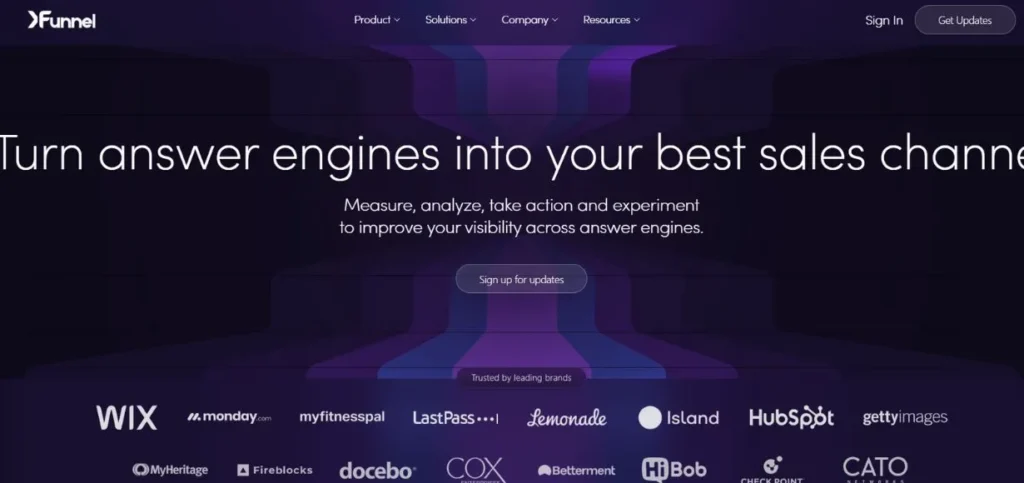
xFunnel AI has a different approach to linking the questions the customers ask directly to the answers offered by the generative engines along the purchasing process. Instead of viewing all visibility as equal, the platform assists teams in realising which content works in answering discovery queries, comparative queries, and conversion-oriented queries.
This business strategy is what sets xFunnel apart as compared to general-purpose monitoring solutions, and it is thus specifically attractive to B2B businesses, SaaS providers, and product teams where buyer journey knowledge is the key to marketing success.
Key Features:
- Buyer journey mapping
- Question-answer correlation
- Competitor gap analysis
- Topic coverage assessment
- Conversion prompt tracking
Pros:
- Journey-focused insights
- Strategic topic guidance
- Product-team alignment
Cons:
- Custom pricing model
- Niche use case
- Learning curve required
Pricing: Custom pricing
12. Geostar
Rating: 4.5/5
Website: https://www.geostar.ai/
Best Use Cases: Brands tracking AI bot behavior and source influence
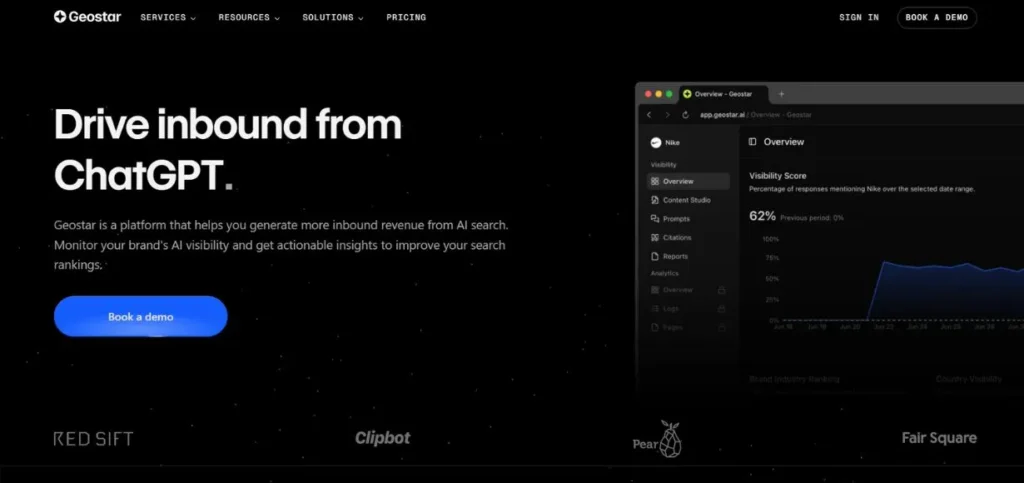
Geostar has capabilities that are not just standard for monitoring visibility, but they go a notch higher by displaying the real interaction of AI bots with websites. These crawl and source-influence insights are priceless to the technical SEO team and brands interested in understanding how the AI systems perceive the content on their sites and how this affects the citations in the answers generated by AI systems.
The platform also provides agency services to those organisations that require professional advice on strategies, content development and continuous optimisation of their visibility. This software and services combination makes Geostar especially appealing to the brands where GEO is a strategic priority.
Key Features:
- AI bot crawl tracking
- Source influence analysis
- Citation origin identification
- Page usage monitoring
- Agency service option
Pros:
- Unique technical insights
- Bot behavior visibility
- Agency support available
Cons:
- Higher entry price
- Technical complexity
- Services increase cost
Pricing: Lite plans start at $249 monthly
13. Search Party
Rating: 4.4/5
Website: https://www.searchparty.com/
Best Use Cases: Organizations wanting real user prompt data across engines
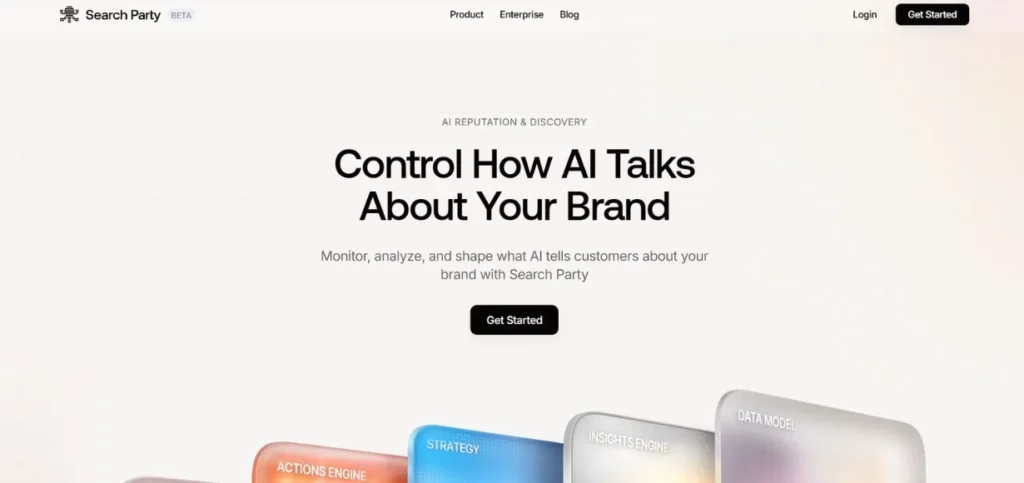
Search Party is unique in that it gathers the real user queries, and you can see how real individuals search AI systems in your industry and brand. Such a solution will provide truer insights compared to websites based on synthetic prompting.
The knowledge of the visibility gaps that actually count in terms of actual user behaviour will help the teams to allocate resources efficiently. The free trial period will enable an organisation to test out the compatibility of the approach used by the platform to their needs before they make the commitment to paid subscriptions.
Key Features:
- Real user prompts
- Multi-engine tracking
- Visibility gap identification
- Opportunity prioritization
- Insights layer analysis
Pros:
- Authentic user data
- Clear prioritization guidance
- Free trial availability
Cons:
- Mid-range pricing
- Limited engine coverage
- Prompt collection methodology
Pricing: Free seven-day trial, then $199 monthly
14. Rankscale
Rating: 4.1/5
Website: https://rankscale.ai/
Best Use Cases: Budget-conscious teams needing basic multi-engine presence tracking
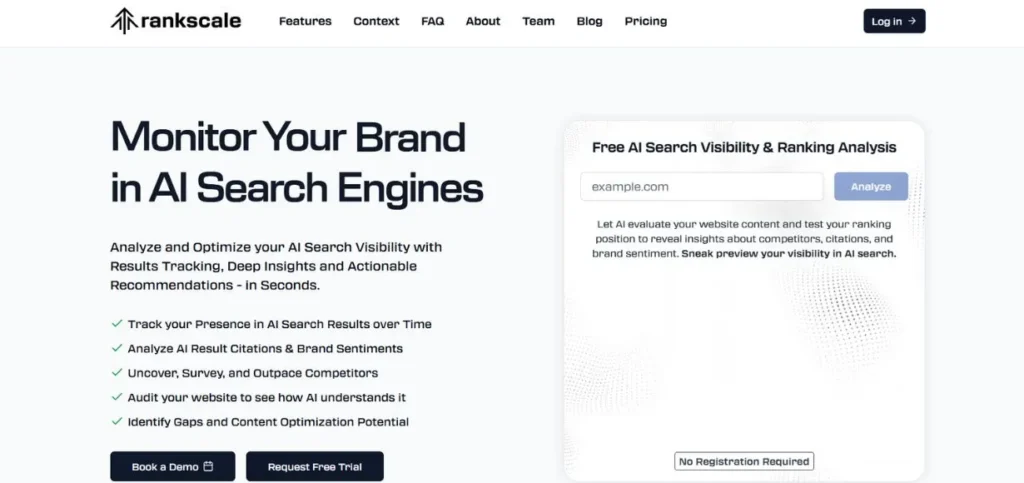
Rankscale is an entry point to professional GEO monitoring, providing the essentials at very affordable prices. The platform offers the brand dashboards that monitor the visibility ratings and the average ranking of the engines, such as ChatGPT, Claude, and Google AI Overviews.
The credit-based system enables the teams to be used on a scale to meet usage needs, thus it is very adaptable to organisations that have different monitoring requirements. Rankscale is the nearest entry option, offering a low-risk opportunity to teams that develop whether GEO Tools of AI Search and SEO Optimisation are worth continuing to invest in, as it offers real utility despite offering low prices.
Key Features:
- Visibility score tracking
- Average position monitoring
- Citation analysis
- AI-readiness audits
- Credit-based scaling
Pros:
- Extremely affordable entry
- Flexible credit system
- Basic audit functionality
Cons:
- Limited feature depth
- Basic reporting options
- Less sophisticated analysis
Pricing: Basic plans begin around $20 monthly
15. Frase
Rating: 4.5/5
Website: https://www.frase.io/
Best Use Cases: Content teams creating AI-ready structured pages and briefs
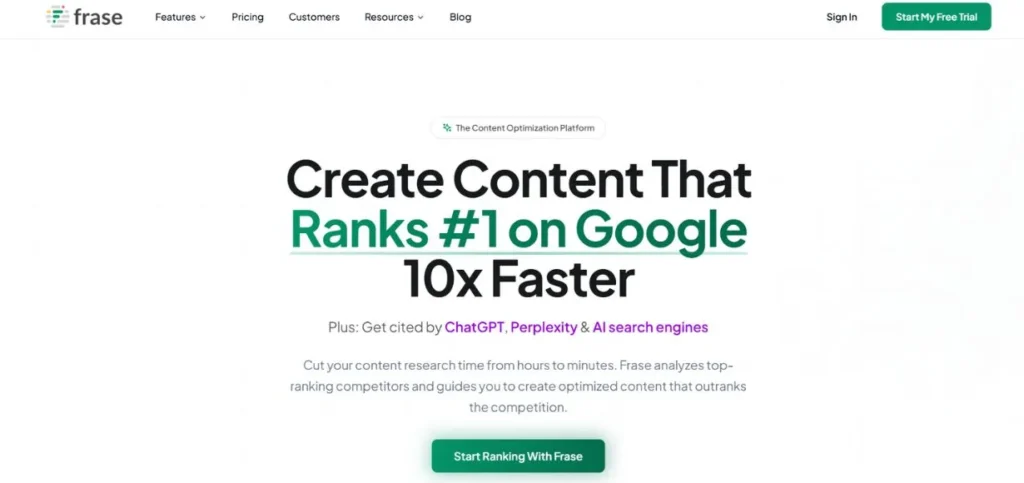
Frase puts a very clear emphasis on aiding writers in generating content that is easy to interpret and cite by the generative engines. Instead of focusing on post-publication monitoring, the platform focuses on pre-publication optimisation – making sure that each article is designed properly and at the beginning.
The workflow integration of the Frase makes the tool especially useful to organisations with content operations that require a strong collaboration of writers, editors, and specialists in SEO. Although Frase does not offer the comprehensive visibility tracking as that of dedicated GEO solutions, the emphasis on content quality and structure is the solution to the essential need of AI citations, as without a well-written, comprehensive content that should be cited, there is nothing to cite.
Key Features:
- Topic coverage analysis
- Question research tools
- Content brief generation
- Structural recommendations
- Query alignment scoring
Pros:
- Writing-focused approach
- Proactive optimization
- Affordable entry pricing
Cons:
- Limited monitoring features
- No competitive analysis
- Requires content focus
Pricing: Plans start at $38 monthly
How to Choose the Right GEO Tools for AI Search & SEO Optimisation
Having fifteen different platforms with different features, the correct choice of the solution depends greatly on the active circumstances of your organisation. The costliest or richest tool is not always the right one because it may not fit into team workflows, technical capacities and strategic priorities of the team.
- Budget Alignment: Review the expenses at present and the expenses that may arise in scaling the GEO program as your GEO program grows.
- Team Size and Structure: Various GEO Tools of AI Search and SEO Optimisation are used at different levels
- Primary Use Case: Elaborate on whether you are focused on proper monitoring, competitive intelligence, content optimisation or overall management of visibility.
- Integration Requirements: Determine the integration of new GEO tools into the current workflows and technology ecosystems.
- Technical Skills: Determine the ability of your team to be comfortable with complex analytics and technical optimisation concepts.
Conclusion
The emergence of generative AI engines has radically changed the online process of finding a brand, product, and information. Visibility in AI generation responses is as vital as any search engine ranking, as conversational interfaces are used as the primary discovery channels. The fifteen GEO Tools to AI Search and SEO Optimisation that were profiled in this guide are the state of the art in the current monitoring, analysis and optimisation of this new paradigm. Both small businesses and large organisations can find something suitable for them: there are low-cost platforms such as the Otterly AI and Rankscale, as well as fully featured solutions such as Profound or Goodie, depending on their level of structure and development of GEO.
Always keep in mind that GEO Tools to AI Search and SEO Optimisation are tools and not strategies. The most influential platform provides low value with no content of quality content, positioning, or regular optimisation. These are the tools that shed light on your position and identify areas in which you need to change, but the key to success lies in what you produce and how you convey your inimitable value. With the discovery process led by AI constantly changing, keeping abreast of the new tools and techniques and with the basic content quality in mind, will determine which brands will flourish in the new environment.
FAQs
Q: What does it mean by GEO and traditional SEO?
A: Traditional SEO is aimed at achieving top positions in the search engine results list, whereas GEO is dedicated to the desire to appear high in the list of AI answers in such programs as ChatGPT, Claude, and Perplexity. GEO needs content structure, authority indicators, and readability to be optimised and not merely aim at the keywords and backlinks.
Q: What is the amount that I should budget for GEO tools?
A: The basic packages begin at $20-39 a month, mid-tier packages cost between 99-250 a month, and enterprise platforms cost $295 or more a month. The budget should include the size of teams, monitoring requirements, and whether it is basic tracking or full optimisation capabilities.
Q: Is it possible to utilise several GEO tools at the same time?
A: Yes, several organisations indeed use monitoring-centric platforms with content-optimisation systems. An example of this is the complementary benefits of Profound and Frase, where one platform has been used to track the data with accuracy and the other to create the content, which is not easy to achieve with a single platform.
Q: What is the time lag or time frame it will take to realise the outcome of GEO optimisation?
A: The responses provided by AI engines are regularly updated, and thus, it may seem better within a few days or weeks following content optimisation. Nonetheless, the development of consistent visibility concerning various topics and queries usually takes 2-3 months of persistent working and tracking.
Q: Do I require GEO tools when I have good SEO rankings?A: Yes, as AI engines do not just mimic conventional search rankings. They are information synthesists who take into account various sources of information depending on the content structure, clarity, and authority, unlike traditional SEO indicators. Good search rankings are advantageous, but not sufficient to ensure AI visibility.
Continue Exploring: Best All-in-One Off-Page SEO Tools