

Finance management of SaaS companies is quite different as compared to traditional businesses. SaaS firms do not focus on the on-time sales but on recurring revenue, subscriptions, upgrades, downgrades, and churn. This complicates accounting and needs software that is capable of addressing such exclusive issues effectively and correctly.
When selecting the appropriate accounting software, it is essential to depend on the ability to track the main SaaS indicators, such as Monthly Recurring Revenue (MRR), Annual Recurring Revenue (ARR), and customer lifetime value. The right tool does not only assist in bookkeeping but also in compliance with the revenue recognition requirements such as ASC 606 which is required in any case as your business expands.
In this article, we have compiled the 15 best Accounting Software for SaaS Companies to automate billing, control subscriptions, and have a better understanding of finances. These tools will keep you organized, save time as well as make smarter decisions related to finances, whether you are a startup or a scaling SaaS business.
Important Qualities of SaaS Accounting Software
- Subscription/ Recurring Billing Support: The software must be able to support both monthly or annual subscriptions, upgrades, and downgrades, and proration without having to do calculations manually.
- Revenue Recognition Compliance: Find a tool that adheres to the requirements of such standards as ASC 606 and IFRS 15 to report on deferred and earned revenue appropriately over time.
- Internalization with SaaS Tools: Fluid integration with applications such as Stripe, CRM applications, and subscription engines allows establishing a profitable financial flow with no data silos.
- Real-Time Financial Insights: Dashboards of MRR, ARR, churn rate and cash flow enable SaaS companies to make decisions faster and based on data.
- Scalability and Multi-Entity: As your SaaS business expands to other countries, the software must be able to operate in multiple currencies, entities, and tax laws without any fuss.
Accounting Software’s Advantages for SaaS Companies
- Financial Tasks Automation: Automates invoicing, billing cycles and reconciliations and minimizes human input and the possibility of error.
- Enhanced Revenue Tracking: Assists in keeping track of the recurrent revenues with high precision, providing a clear overview of the business performance and its growth patterns.
- Enhanced Compliance and Accuracy: Makes sure that there is good management of taxes and revenue reporting which is very important when it comes to audit or even fundraising.
- Time-Saving to Teams: Eliminates manual bookkeeping to enable founders and finance teams to work on strategy and growth.
- Improved Decision-Making: Includes supplementary financial reports and SaaS-specific metrics which can be utilized to enhance planning and forecasting.
List of 15 Best Accounting Software for Saas Companies
1. NetSuite
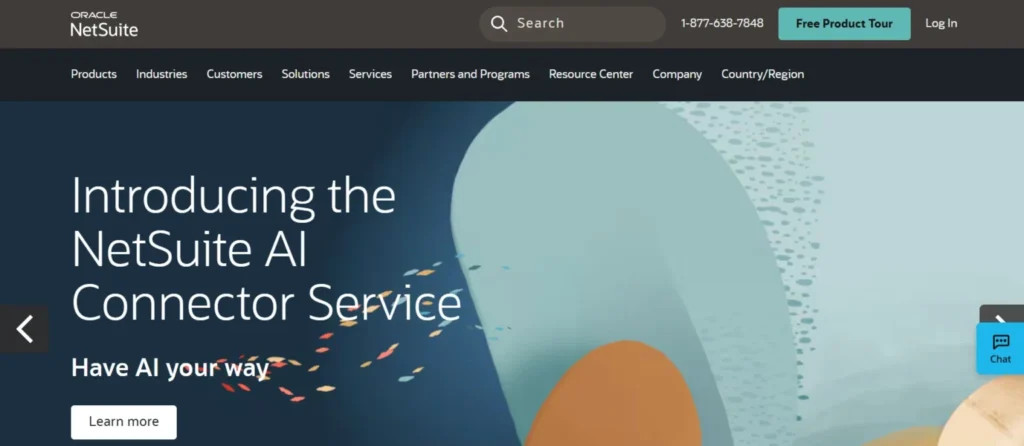
NetSuite is one of the most powerful cloud-based ERP and accounting solutions, widely used by SaaS companies that are scaling rapidly. It offers a unified platform that combines financial management, billing, revenue recognition, and reporting—all critical for subscription-based businesses. SaaS companies benefit from its ability to automate complex accounting processes and maintain compliance with global standards like ASC 606 and IFRS 15.
Another key strength of NetSuite is its flexibility and scalability. Whether you’re a startup or an enterprise SaaS company, NetSuite adapts to your growth by supporting multi-entity, multi-currency, and global tax requirements. Its real-time dashboards and analytics help finance teams make data-driven decisions quickly, which is essential in a fast-moving SaaS envir₹onment.
Top Features:
- Automated revenue recognition (ASC 606/IFRS 15 compliant)
- Subscription billing and invoicing
- Real-time financial dashboards
- Multi-currency and multi-entity support
- Advanced reporting and forecasting
Website: https://www.netsuite.com
Pricing: Available on request
2. QuickBooks Online
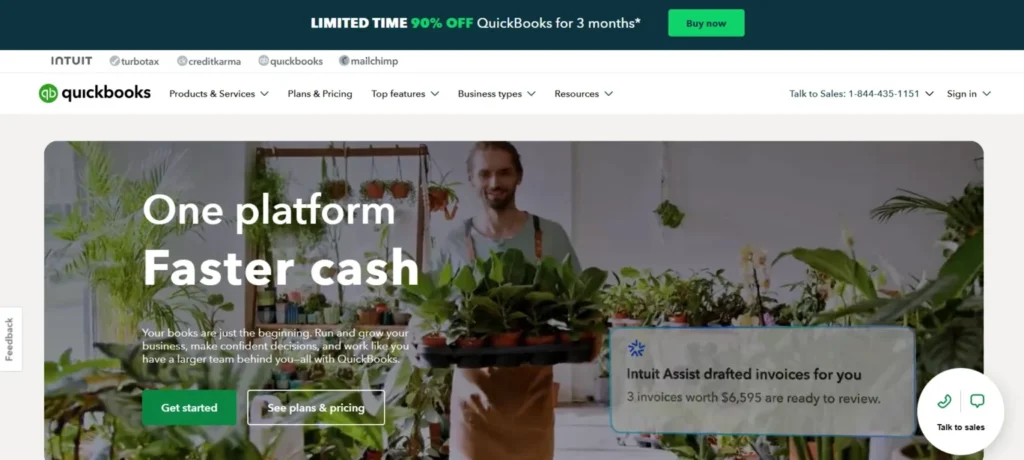
QuickBooks Online is a popular choice among small to mid-sized SaaS companies due to its simplicity and affordability. It provides essential accounting features like expense tracking, invoicing, and financial reporting, making it ideal for startups that need a reliable yet easy-to-use solution. Its cloud-based nature allows teams to access financial data anytime, anywhere. As accounting software for saas companies, it offers a practical balance between functionality and ease of use.
While it may not be as advanced as enterprise tools, QuickBooks Online integrates well with many SaaS-specific tools like Stripe, PayPal, and subscription billing platforms. This makes it a practical option for early-stage SaaS businesses that want to streamline their accounting without investing heavily in complex systems.
Top Features:
- Easy invoicing and expense tracking
- Bank reconciliation automation
- Integration with payment gateways
- Basic financial reporting
- Cloud-based access
Website: https://quickbooks.intuit.com
Pricing:
| Start | Essential | Plus | Advanced |
| $19/mo | $37.50/mo | $57.50/mo | $137.50/mo |
3. Xero
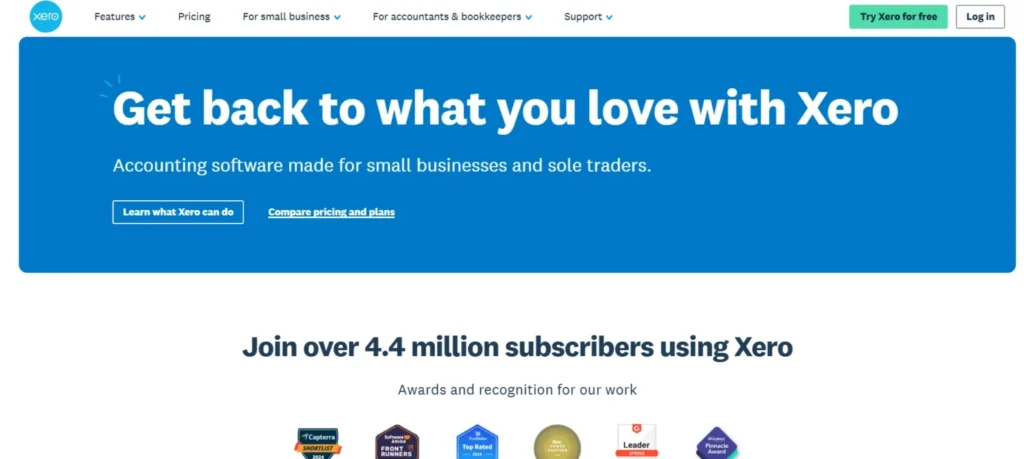
Xero is a modern cloud accounting software designed for growing businesses, including SaaS companies. It offers a clean interface and strong automation capabilities, helping finance teams reduce manual work. Xero is especially known for its seamless bank integrations and real-time financial tracking.
For SaaS businesses, Xero supports integrations with subscription management tools, making it easier to handle recurring billing and revenue tracking. Its ecosystem of third-party apps allows companies to customize their accounting workflows, which is a major advantage for tech-driven businesses.
Top Features:
- Real-time bank feeds and reconciliation
- Integration with SaaS billing tools
- Automated invoicing and payments
- Multi-currency support
- Extensive app marketplace
Website: https://www.xero.com
Pricing:
| Starter | Standard | Premium |
| $2.90/mo | $5/mo | $7.50/mo |
4. Sage Intacct
Sage Intacct is a robust cloud financial management solution tailored for growing SaaS companies. It excels in handling complex financial processes like revenue recognition, subscription billing, and multi-entity consolidations. Its strong compliance capabilities make it a preferred choice for companies preparing for audits or IPOs. As accounting software for saas companies, it is particularly well-suited for businesses with advanced financial needs.
One of Sage Intacct’s biggest advantages is its deep financial visibility. It provides detailed reporting and dashboards that allow SaaS companies to track KPIs like MRR, ARR, and churn. This makes it not just an accounting tool, but a strategic finance platform.
Top Features:
- Advanced revenue recognition
- Multi-entity and multi-dimensional accounting
- Real-time financial reporting
- SaaS metrics tracking (MRR, ARR)
- Strong compliance and audit readiness
Website: https://www.sageintacct.com
Pricing: Available on request
5. FreshBooks
FreshBooks is a user-friendly accounting software designed for small businesses and startups, including early-stage SaaS companies. It focuses on simplicity, making it easy for non-finance professionals to manage invoices, expenses, and financial reports without much training.
Although it is not as feature-rich as enterprise tools, FreshBooks is ideal for SaaS founders who want a lightweight solution to manage their finances. Its intuitive interface and automation features help save time, allowing teams to focus more on product development and growth.
Top Features:
- Simple invoicing and expense tracking
- Time tracking and project billing
- Automated payment reminders
- Easy-to-understand reports
- Cloud-based and mobile-friendly
Website: https://www.freshbooks.com
Pricing: Available on request
6. Zoho Books
Zoho Books is a comprehensive and affordable accounting solution that fits well for small to mid-sized SaaS companies. It offers end-to-end financial management, including invoicing, expense tracking, tax compliance, and automation. Being part of the Zoho ecosystem, it integrates seamlessly with other Zoho apps like CRM and subscriptions, making it a strong choice for SaaS businesses.
For SaaS companies specifically, Zoho Books supports recurring billing and automated workflows, helping manage subscription-based revenue efficiently. Its user-friendly interface and strong automation capabilities reduce manual effort, while its affordability makes it especially attractive for startups and growing teams.
Top Features:
- Recurring billing and subscription management
- Automated workflows and approvals
- GST and global tax compliance
- Integration with Zoho ecosystem
- Real-time financial reporting
Website: https://www.zoho.com/books
Pricing:
| Standard | Professional | Premium | Elite |
| $8.09/mo | $16.19/mo | $32.39/mo | $54.00/mo |
7. Chargebee
Chargebee is a specialized subscription billing and revenue management platform designed specifically for SaaS companies. While it is not a traditional accounting tool, it integrates deeply with accounting systems to handle subscription lifecycle management, invoicing, and revenue recognition with precision. As accounting software for saas companies, it plays a critical supporting role alongside core financial systems.
It is particularly useful for SaaS businesses dealing with complex pricing models, multiple plans, and global customers. Chargebee automates billing cycles, manages upgrades/downgrades, and ensures compliance with revenue recognition standards, making it an essential tool for scaling SaaS companies.
Top Features:
- Subscription lifecycle management
- Automated billing and invoicing
- Revenue recognition compliance (ASC 606)
- Integration with accounting tools like Xero and QuickBooks
- Multi-currency and global payments support
Website: https://www.chargebee.com
Pricing:
| Performance | Enterprise |
| 6207.61/yr | Available on request |
8. Paddle

Paddle is an all-in-one revenue delivery platform tailored for SaaS businesses, combining billing, payments, tax handling, and compliance into a single solution. It acts as a Merchant of Record, meaning it takes care of global tax compliance and payment processing, reducing operational complexity for SaaS companies.
This makes Paddle especially valuable for SaaS startups expanding internationally. Instead of managing multiple tax regulations and payment gateways, companies can rely on Paddle to handle everything, allowing them to focus on growth and product development.
Top Features:
- Merchant of Record (handles taxes and compliance)
- Subscription billing and payments
- Global payment support
- Built-in fraud protection
- Revenue analytics and reporting
Website: https://www.paddle.com
Pricing: Available on request
9. Wave Accounting
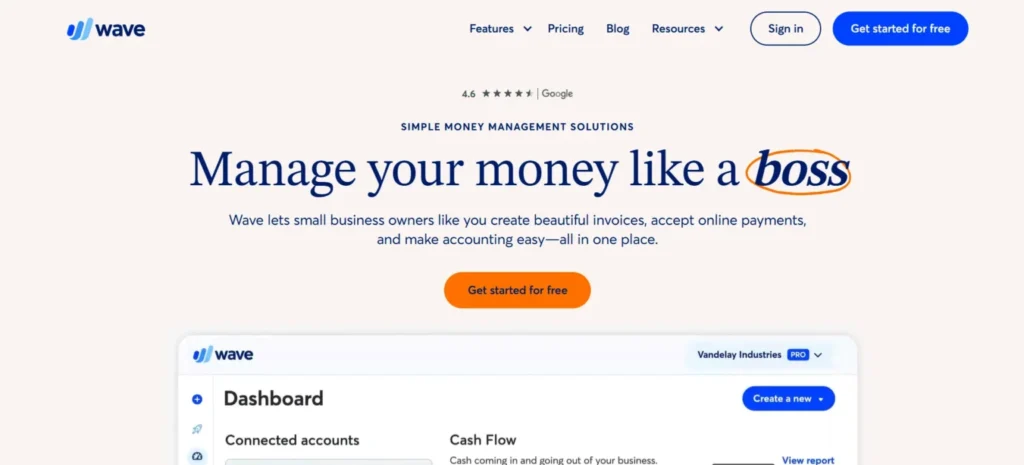
Wave Accounting is a free, cloud-based accounting software ideal for very early-stage SaaS startups or solo founders. It provides essential accounting features like invoicing, expense tracking, and basic reporting without any subscription cost, making it a budget-friendly option.
Although it lacks advanced SaaS-specific features, Wave can still be useful for managing basic finances in the early stages. As the business grows, companies often migrate to more advanced platforms, but Wave serves as a great starting point.
Top Features:
- Free invoicing and accounting
- Expense and income tracking
- Bank connection and reconciliation
- Basic financial reports
- Simple and easy-to-use interface
Website: https://www.waveapps.com
Pricing:
| Starter | Pro |
| $0 | $190/yr |
10. Recurly
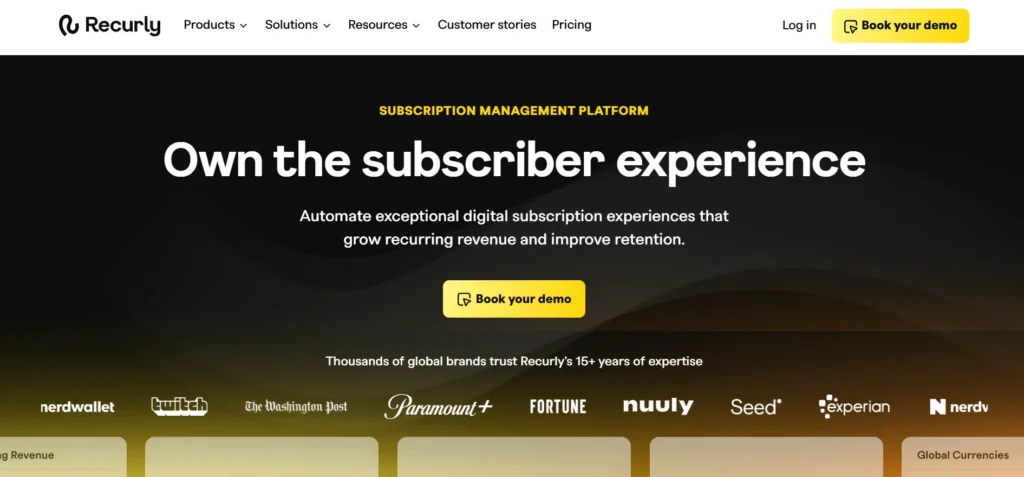
Recurly is a subscription billing platform built specifically for SaaS and subscription-based businesses. It focuses on optimizing recurring revenue through automated billing, churn management, and flexible subscription models. It integrates with major accounting platforms to ensure accurate financial tracking.
One of Recurly’s standout features is its ability to reduce churn through smart retry logic and dunning management. For SaaS companies, this directly impacts revenue growth. Its analytics and reporting tools also provide valuable insights into subscriber behavior and revenue trends.
Top Features:
- Advanced subscription billing
- Churn management and dunning tools
- Flexible pricing and plan management
- Integration with accounting systems
- Detailed revenue analytics
Website: https://www.recurly.com
Pricing: Available on request
11. Stripe Billing
Stripe Billing is a powerful subscription management and billing solution built by Stripe, widely used by SaaS companies worldwide. It enables businesses to handle recurring payments, invoicing, and subscription lifecycle management with ease. Its deep integration with Stripe’s payment infrastructure ensures smooth and reliable transactions. As accounting software for saas companies, it complements financial systems by streamlining billing operations.
For SaaS companies, Stripe Billing provides flexibility in pricing models, including tiered, usage-based, and per-seat billing. It also supports global payments and automatic tax handling, making it ideal for companies with international customers. Its developer-friendly APIs allow for high customization, which is a big advantage for tech-driven teams.
Top Features:
- Flexible subscription and pricing models
- Automated recurring billing
- Global payment and tax support
- Smart invoicing system
- Developer-friendly APIs
Website: https://stripe.com/billing
Pricing: Available on request
12. Kashoo
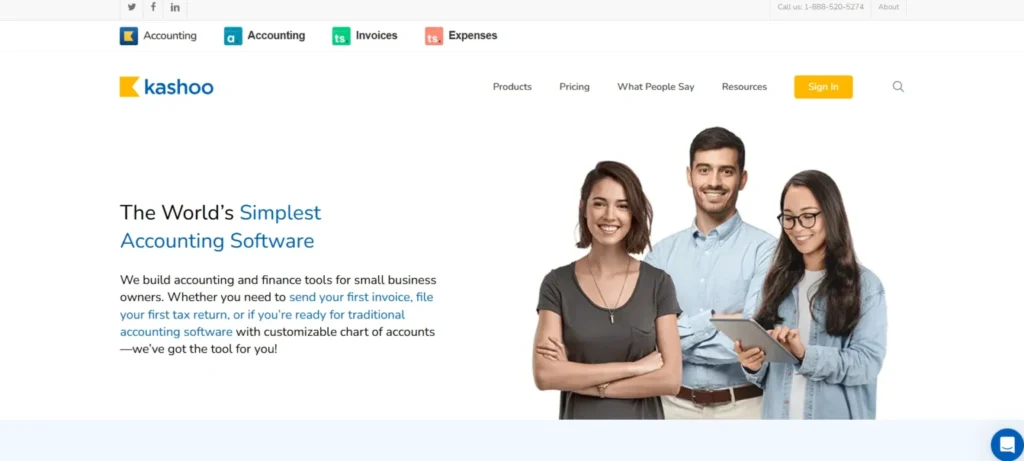
Kashoo is a simple yet effective cloud accounting software designed for small businesses and startups. It focuses on automating everyday accounting tasks like expense tracking, invoicing, and bank reconciliation, making it easy for SaaS founders to manage finances without deep accounting knowledge.
Kashoo is particularly useful for early-stage SaaS companies that need a straightforward solution without unnecessary complexity. Its automation features reduce manual work, while its clean interface ensures a smooth user experience.
Top Features:
- Automated transaction categorization
- Simple invoicing and expense tracking
- Real-time bank feeds
- Basic financial reporting
- Easy setup and usability
Website: https://www.kashoo.com
Pricing: $30/mo
13. FreeAgent
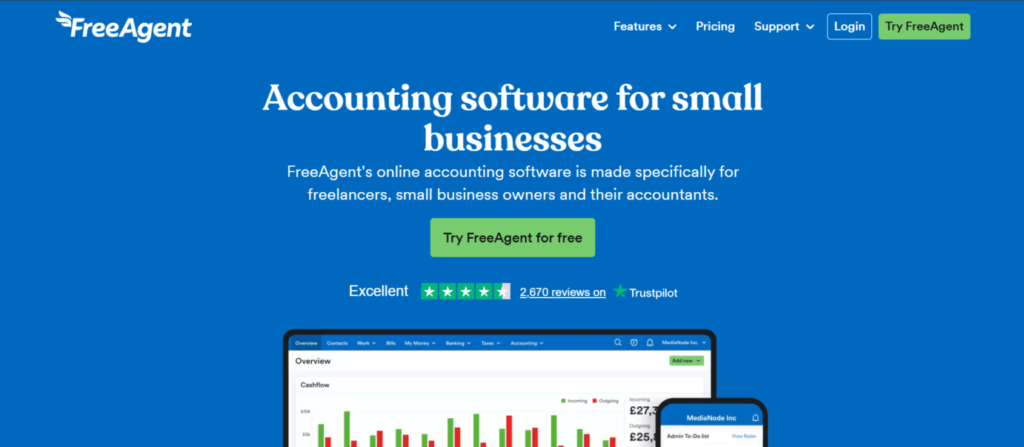
FreeAgent is a cloud-based accounting software tailored for freelancers, startups, and small businesses, including SaaS companies. It offers a well-rounded set of features such as invoicing, expense tracking, tax management, and financial reporting.
For SaaS businesses, FreeAgent helps manage recurring invoices and provides clear insights into cash flow and profitability. Its intuitive dashboard and automation capabilities make it easy for small teams to stay on top of their finances without needing dedicated accounting staff.
Top Features:
- Recurring invoicing
- Expense and project tracking
- Tax management and filing support
- Cash flow insights
- User-friendly dashboard
Website: https://www.freeagent.com
Pricing:
| Free | Monthly | Annual |
| $0 | $14.30/mo | $143.04/yr |
14. Odoo Accounting
Odoo Accounting is part of the Odoo ERP suite and is a powerful yet flexible accounting solution for SaaS companies. It offers a wide range of features including invoicing, billing, bank synchronization, and financial reporting, all within a single integrated platform. Since it’s modular, SaaS companies can easily extend it with CRM, subscriptions, and other business apps. As accounting software for saas companies, it provides an all-in-one approach to managing finances and operations.
For SaaS businesses, Odoo is particularly useful because of its built-in subscription management module. It allows companies to manage recurring billing, automate invoices, and track customer lifecycles efficiently. Its open-source nature and customization options make it a great choice for companies that want control and scalability.
Top Features:
- Integrated subscription and billing management
- Automated invoicing and bank synchronization
- Modular ERP system (CRM, Sales, Inventory, etc.)
- Customizable and open-source flexibility
- Real-time reporting and dashboards
Website: https://www.odoo.com
Pricing:
| Free | Standard | Custom |
| $0 | $6.26/mo | $9.61/mo |
15. Maxio
Maxio is a purpose-built financial operations platform designed specifically for SaaS companies. It combines subscription billing and advanced revenue recognition, making it ideal for B2B SaaS businesses with complex pricing models. It helps companies manage the entire revenue lifecycle, from billing to reporting.
What makes Maxio stand out is its strong focus on SaaS metrics and compliance. It provides detailed insights into MRR, ARR, churn, and deferred revenue, while also ensuring compliance with accounting standards like ASC 606. This makes it a great choice for scaling SaaS companies that need deeper financial visibility and control.
Top Features:
- Advanced revenue recognition (ASC 606 compliant)
- Subscription billing and lifecycle management
- SaaS metrics tracking (MRR, ARR, churn)
- Deferred revenue and reporting tools
- Integration with accounting systems like QuickBooks and Xero
Website: https://www.maxio.com
Pricing: Available on request
Comparison Table
| Software Name | Best For | Key Strength | Subscription Billing | Scalability |
| NetSuite | Enterprise SaaS | All-in-one ERP | Yes | High |
| QuickBooks Online | Startups/SMBs | Ease of use | Limited (via integrations) | Medium |
| Xero | Growing SaaS | Strong integrations | Yes (via integrations) | Medium |
| Sage Intacct | Scaling SaaS | Advanced financials | Yes | High |
| FreshBooks | Early-stage SaaS | Simple UI | Limited | Low |
| Zoho Books | SMBs | Affordable & automation | Yes | Medium |
| Chargebee | Subscription SaaS | Billing automation | Yes (core feature) | High |
| Paddle | Global SaaS | Merchant of Record | Yes | High |
| Wave Accounting | Solo founders | Free tool | No | Low |
| Recurly | Subscription SaaS | Churn management | Yes | High |
| Stripe Billing | Tech SaaS | Flexible APIs | Yes | High |
| Kashoo | Small SaaS | Automation simplicity | No | Low |
| FreeAgent | Small teams | Ease of use | Yes (basic) | Low |
| Odoo Accounting | Custom SaaS | Modular ERP | Yes | High |
| Maxio | B2B SaaS | Revenue recognition | Yes | High |
Conclusion
In conclusion, selecting the appropriate accounting software is extremely crucial to any SaaS firm. As a SaaS business operates under a subscription and recurrent revenue model, it will require software that will not confuse with billing, revenue recognition, and financial tracking. The appropriate software not only make the process of accounting very easy, but also provides you with a clear picture of the performance of your business. Choosing accounting software for saas companies ensures your financial operations stay streamlined and scalable.
No matter whether you are a startup with a simple and affordable tool you need, or you are a growing company and require advanced features, there are many alternatives to choose. The trick is to pick software that suits your present requirements, and also, which will be able to meet your business later. With the appropriate accounting tool, you will be able to save time, minimize errors, and devote more attention to the development of your SaaS business.
FAQs
Which Accounting Software Is Best For SaaS Startups?
For startups, tools like QuickBooks Online, Zoho Books, and FreshBooks are good choices because they are easy to use, affordable, and offer essential features needed in the early stages.
Do SaaS Companies Need Revenue Recognition Features?
Yes, revenue recognition is very important for SaaS companies. It ensures that revenue is recorded correctly over time, especially for annual or multi-month subscriptions, and helps with compliance.
Can I Use Regular Accounting Software For A SaaS Business?
You can use regular accounting software, but it may not fully support SaaS-specific needs like recurring billing or subscription management. It’s better to choose tools designed for SaaS or integrate with subscription platforms.
What Is MRR And Why Is It Important?
MRR (Monthly Recurring Revenue) is the predictable income a SaaS company earns every month. It helps measure business growth, stability, and future revenue potential.
When Should I Upgrade My Accounting Software?
You should consider upgrading when your business grows, starts handling multiple subscriptions, expands globally, or needs advanced reporting and compliance features.